
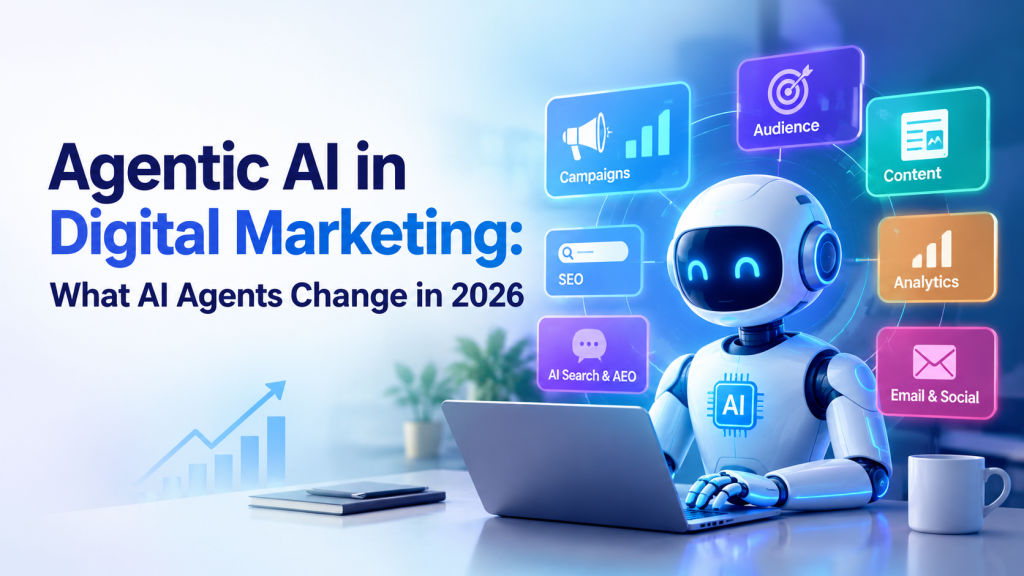
Agentic AI in Digital Marketing: What AI Agents Change in 2026
Marketing software has moved through several phases. First came rule-based automation: if a lead downloads an ebook, send email #2. Then came AI-assisted tools that suggested subject lines or bid changes. Generative AI followed, and it made drafting copy, images, and video far cheaper. Now the conversation has shifted to Agentic AI: systems that pursue a goal across several steps, use tools, and adjust as results come in.
2026 is when this moved from conference talk to product roadmaps. Amazon Ads, Adobe, and Google all describe agent-style tools inside their platforms. Gartner predicts that 40% of enterprise applications will be integrated with task-specific AI agents by the end of 2026, up from less than 5% in 2025. That is a forecast, not a measurement of marketing results. The same period also carries a warning: Gartner has said more than 40% of agentic AI projects may be canceled by 2027, citing costs, unclear business value, and weak risk controls.
This guide covers what agentic AI is, how it works, where it fits in digital marketing, what it means for SEO, AEO, and GEO, and how to adopt it without losing control of your brand.
What Is Agentic AI?
Agentic AI is artificial intelligence that can pursue a defined goal by planning steps, using tools, and adapting to results, with limited human intervention. Amazon Ads describes it as AI that makes decisions and takes actions toward specific goals, in contrast to traditional AI that waits for a command.
A few related terms:
- AI agent: a software system that uses AI to pursue goals and complete tasks on a user’s behalf. According to Google Cloud, agents show reasoning, planning, and memory, plus some autonomy.
- Autonomous AI: AI that acts without a person approving every step. Autonomy is a spectrum, not an on/off switch.
- Agentic system: one or more agents plus the tools, data, permissions, and rules around them.
- Agentic workflow: a multi-step process an agent runs, such as researching, drafting, checking, publishing, and reporting.
The difference from a chatbot is easiest to see with an example. Ask a generative AI tool, “Write five headlines for our webinar,” and you get five headlines. Give an agent the goal “Fill this webinar with qualified attendees,” and it might review past registration data, find which audiences converted, draft new ad variants, propose a budget split, and check registrations daily. You still set the goal, the budget, and the boundaries.
How Does Agentic AI Work in Digital Marketing?
Vendors describe the cycle slightly differently. Amazon Ads uses four stages: perception, reasoning, execution, and adaptation. In practice the loop looks like this:
- Perceive and gather context. The agent pulls data from ad platforms, analytics, CRM, and email tools.
- Reason. It interprets what the data means against the goal.
- Plan. It breaks the goal into steps and picks an order.
- Use tools. It calls the APIs and interfaces it has been permitted to use.
- Decide and execute. It takes an action, such as adjusting a segment or drafting a variation, within its permissions.
- Monitor and adapt. It checks outcomes, learns from them, and revises the plan.
A practical example. Goal: increase qualified leads for a B2B software company.
The agent analyzes campaign data and finds that one segment generates clicks but few sales-accepted leads. It proposes narrower targeting, drafts alternative ad copy, and evaluates existing creative against past performance. It then watches conversions for a set period and reports what changed. In a well-governed setup, a marketer approves the budget shift before it goes live.
How this differs from rule-based automation. A traditional workflow only does what someone explicitly programmed: “If score > 50, notify sales.” An agent can decide which analysis to run, which tool to call, and what to try next. That flexibility is also why agents need guardrails. Rules are predictable, while agents are adaptive and can be wrong in less predictable ways.
Agentic AI vs Generative AI vs Traditional Marketing Automation
These categories overlap, and most real products combine several. Adobe’s own framing is that generative AI speeds up creating content, while agentic AI helps execute the work around it, and that the two work best together.
These categories overlap, and most real products combine several. Adobe’s own framing is that generative AI speeds up creating content, while agentic AI helps execute the work around it, and that the two work best together.
| Traditional automation | Generative AI | AI assistant | AI agent | Agentic AI (system) | |
|---|---|---|---|---|---|
| How it operates | Fixed rules and triggers | Produces content from a prompt | Responds to requests in a conversation | Pursues a goal with tools | Agents plus orchestration and governance |
| Autonomy | None | Low | Low | Medium to high | Varies by design |
| Decision-making | Pre-programmed | Suggests, doesn’t decide | Recommends; user decides | Makes bounded decisions | Coordinates decisions across agents |
| Planning | None | Minimal | Minimal | Multi-step | Multi-step, cross-function |
| Execution | Runs defined actions | Outputs text/images | Completes simple tasks | Acts via connected tools | Acts across systems |
| Adaptability | Low | Low | Moderate | Higher | Higher, with feedback loops |
| Human involvement | Sets up rules | Prompts and edits | Directs every step | Sets goals, reviews | Sets goals, governance, approvals |
| Marketing use | Drip emails, lead routing | Copy, images, video | Drafting, Q&A, summaries | Campaign monitoring, audience building | End-to-end journey and campaign orchestration |
Google Cloud draws a similar line: assistants respond to prompts and recommend actions while users make decisions, whereas agents are proactive and goal-oriented. Treat these as layers rather than replacements. A rule-based email flow, a generative model writing variants, and an agent monitoring results can all run in the same stack.
Key Characteristics of Agentic AI in Marketing
- Autonomy: The agent can launch tests or adjust settings without waiting for sign-off on every step. Amazon Ads notes that oversight remains for critical decisions.
- Goal orientation: You give it an outcome such as “lower cost per qualified lead,” not a list of clicks.
- Reasoning: It weighs evidence, for example whether a conversion dip is seasonal or campaign-related.
- Context awareness: It draws on brand guidelines, audience data, and campaign history.
- Planning: It sequences work, such as research before creative and creative before testing.
- Tool use: It calls ad platforms, analytics, CMS, CRM, and email systems.
- Adaptability: It changes course as performance shifts.
- Real-time responsiveness: It monitors continuously rather than in weekly reviews.
- Memory: It retains past results and preferences. Google Cloud describes short-term, long-term, and episodic memory in agent designs.
- Multi-step execution: It connects tasks that used to be handled by different people.
- Scalability: One agent can watch hundreds of campaigns or segments.
- Multi-agent collaboration: Specialized agents, such as planning, creative, and analytics, hand work to each other.
- Human oversight: Approvals, permissions, and audit trails keep the system accountable.
How Agentic AI Is Changing Digital Marketing in 2026
The table below covers the fifteen shifts marketers are most often discussing. Examples are illustrative scenarios, not case studies.
| Use case | What the agent does | Benefit | Human approval still needed | Realistic example |
|---|---|---|---|---|
| Campaign planning | Turns a brief into tasks, timelines, and channel plans | Faster, more consistent planning | Strategy, budget, positioning | A brief becomes a launch plan across three regions; the marketing lead adjusts priorities |
| Campaign execution | Builds and schedules assets across tools | Less manual setup | Final launch approval | Ads and landing-page variants are staged for review |
| Real-time optimization | Watches metrics and proposes or applies changes | Quicker response | Large budget shifts | Spend moves from an underperforming ad set to a stronger one within set limits |
| Personalized experiences | Selects content or offers by segment and behavior | Relevance at scale | Sensitive segments, offers | Returning visitors see a different landing-page message |
| Content workflows | Researches, drafts, adapts, routes for review | Reduced production time | Editorial and legal review | A single brief becomes email, web, and social drafts |
| Marketing analytics | Answers questions in plain language, flags anomalies | Faster insight | Interpretation and decisions | “Why did signups drop Tuesday?” gets an evidence-backed summary |
| Lead scoring and nurturing | Prioritizes leads and adjusts follow-up | Better sales focus | Scoring criteria, outreach rules | High-intent trial users are flagged for sales |
| Email marketing | Tests timing, subject lines, and sequences | Continuous testing | Compliance, brand voice | Send-time tests run automatically; copy is approved beforehand |
| Social media management | Drafts, schedules, and monitors engagement | Consistent presence | Public-facing replies, crises | Posts are queued; sensitive replies go to a person |
| Paid advertising | Adjusts bids, budgets, and creative | Efficiency gains | Budget ceilings, brand safety | The agent pauses ads with rising cost per acquisition |
| Audience segmentation | Builds and refines segments from prompts | Less rule-writing | Privacy and eligibility checks | A marketer describes an audience in plain language; the agent proposes attributes |
| Journey orchestration | Designs multi-step journeys, flags overlaps | Fewer duplicate or mistimed messages | Journey logic, customer rules | The agent spots a customer getting two conflicting emails |
| Conversion optimization | Proposes and prioritizes tests | Faster experimentation | Test approval, statistical judgment | Suggests testing a shorter form on a high-drop page |
| Predictive marketing | Estimates churn, intent, or demand | Earlier action | Model validation, ethics | Flags subscribers likely to lapse |
| Cross-channel orchestration | Coordinates messaging and budget across channels | Consistent experience | Channel strategy | Search, email, and social messages stay aligned |
Both Amazon Ads and Adobe stress that these capabilities are tied to their own platforms. Adobe, for instance, describes agents inside Adobe Experience Platform for planning, audience management, content, journeys, and analysis. These are vendor perspectives on their own products, not independent benchmarks.
Agentic AI Use Cases in Digital Marketing
The strongest use cases connect several steps rather than completing one isolated task.
AI Agents for SEO
An agent can pull Search Console data, spot pages losing impressions, compare them to competitors, and draft refresh recommendations. Editors decide what to publish.
AI Agents for Content Marketing
Agents can build briefs from research, draft outlines, check terminology against a style guide, and route drafts for review. Original insight still has to come from people.
AI Agents for Paid Search and Advertising
Agents can monitor spend, flag wasted queries, test creative, and adjust bids within limits. Amazon Ads’ Ads Agent, for example, is described as handling tasks like pacing adjustments and campaign setup from media plans.
AI Agents for Social Media Marketing
They can draft posts, propose timing, and summarize sentiment. Replies to complaints or sensitive topics should stay with humans.
AI Agents for Email Marketing
Agents can test send times, segment audiences, and personalize sequences, while compliance and tone stay under human review.
AI Agents for Lead Generation and Lead Nurturing
An agent can rank leads by engagement, suggest follow-ups, and alert sales when intent rises. Scoring logic should be reviewed for bias and accuracy.
AI Agents for Customer Journey Optimization
Agents can detect drop-offs, propose fixes, and prevent message collisions across channels.
AI Agents for Marketing Analytics
Natural-language analysis lets marketers ask questions of their data. Verify the numbers before acting on them.
AI Agents for Personalization
They adapt messages, products, or offers by context. Keep personalization within your privacy commitments.
AI Agents for Conversion Rate Optimization
Agents can prioritize test ideas, monitor experiments, and summarize results. People must judge whether the result is statistically and commercially meaningful.
AI Agents for Marketing Reporting
Weekly reports can be assembled automatically, with the agent explaining changes. A human should own the narrative sent to leadership.
Multi-Agent Marketing Workflows
Multi-agent setups use specialists: one plans, one creates, one analyzes, one checks brand rules. Google Cloud describes multi-agent systems as multiple agents collaborating toward shared objectives. The upside is coverage; the downside is more places for errors to compound.
Agentic AI and SEO: What Changes for Search Marketers?
Agents can take on much of the repetitive SEO workload:
- Keyword research and intent analysis: clustering queries and classifying intent.
- Content briefs: assembling headings, questions, and entities from SERP research.
- Competitor analysis: tracking content gaps and changes.
- Content optimization and refreshes: flagging stale pages and suggesting updates.
- Internal linking: proposing relevant links between pages.
- Technical monitoring: watching for crawl errors, broken links, and indexing issues.
- Performance analysis and reporting: summarizing what moved and why.
There is one distinction to keep clear. AI can help you execute SEO tasks, but it does not control rankings. Visibility is decided by search engine systems and by the quality and relevance of your content. No agent can guarantee rankings, and Google itself warns that indexing and serving are never guaranteed even when a page follows best practices.
Agentic AI, AEO and the Rise of AI-Powered Search
Answer Engine Optimization (AEO) is the practice of shaping content so that AI-driven search and answer tools can find, understand, and present it. Users increasingly get synthesized answers from Google’s AI Overviews and AI Mode, and from ChatGPT, Gemini, and Perplexity, sometimes without clicking a traditional blue link.
Google’s own framing matters here. It describes AEO and GEO as terms for work aimed at visibility in AI search, and says that from Search’s perspective, optimizing for generative AI search is still SEO. Neither AEO nor GEO is an official Google ranking factor. In Google’s words, its AI features are rooted in its core ranking and quality systems, using techniques such as retrieval-augmented generation and query fan-out.
So it helps to separate three ideas:
- Google Search/SEO: the established discipline, per Google’s documentation.
- AEO: a marketing practice focused on being the source behind direct answers.
- GEO: a broader, still-forming concept covering visibility across generative systems.
What works in practice is content that answers questions clearly, is well organized, and shows real expertise. That approach supports visibility, but nothing guarantees inclusion in an AI answer. For Google-specific guidance, see Google’s guidance for optimizing websites for AI Overviews and AI search.
Agentic AI and GEO: Optimizing for Generative AI Recommendations
Generative Engine Optimization (GEO) is the effort to make a brand accurately discoverable and recommendable inside generative AI systems. It is an evolving area with no single proven formula, and different platforms retrieve and cite information differently.
Commonly discussed factors include:
- Brand mentions and reputation: what credible sources, reviews, and communities say about you.
- Entity clarity: making it obvious who you are, what you offer, and how your products relate.
- Topical authority: deep, consistent coverage of your subject area.
- Factual consistency: the same details across your site, profiles, and listings.
- Citations and sources: referencing credible sources and being referenced.
- Website quality and structured information: crawlable, well-organized pages and accurate business data.
- Digital PR and reviews: earned coverage and genuine customer feedback.
Google adds two cautions for its own systems. Seeking inauthentic mentions is less useful than it may seem, and there is no need to write differently for AI, break content into artificial chunks, or create special files such as llms.txt. Authentic reputation and genuinely useful content are the safer foundation. For a fuller walkthrough, this guide on how to get your brand recommended by ChatGPT, Gemini and Perplexity covers the practical side.
Agentic AI and AI-Generated Content vs Human Content
Agents can reshape each stage of content work: research, brief creation, drafting, optimization, fact-checking, distribution, performance monitoring, and refreshes. That can cut production time considerably.
But using AI does not make content good. Google’s guidance says the content most likely to help long-term visibility offers a unique point of view and experience, not a rehash of what already exists or what a model could easily generate. Human expertise, original insight, factual accuracy, and careful editing are what separate useful pages from commodity ones. This comparison of AI-generated content vs human content for SEO in 2026 explores that balance in more depth. Google also notes that mass-producing pages mainly to capture query variations can violate its scaled content abuse policy, which is exactly the trap an unsupervised content agent can fall into.
How Agentic AI Is Changing Search and SEO Strategies in 2026
Google’s official Search announcements from I/O 2026 describe Gemini 3.5 Flash as the new default model in AI Mode globally, along with expanded agentic booking for services and local experiences. Coverage of the same period notes that Google says AI Mode is not the default search experience, so treat claims that it has replaced regular results with caution. The surfaces are converging, though: AI Overviews now hand off into AI Mode.
For marketers, this means several things at once: more conversational, multi-step search journeys; possible zero-click outcomes where the answer appears on the results page; and shifting SERP visibility. Google’s Search Console now offers a Generative AI performance report for measuring how content appears in these features.
The practical response is additive. Keep the SEO fundamentals, then widen your measurement and content coverage for AI-driven discovery. This overview of AI SEO strategies for Google AI Overviews and AI Mode in 2026 shows how teams are adapting. Because rollout varies by country and language, check what is live in your market before rebuilding a strategy around it.
AEO vs SEO: What Marketers Need to Know
| SEO | AEO | GEO | |
|---|---|---|---|
| Primary objective | Rank and earn clicks in search results | Be the source behind direct answers | Be accurately represented and recommended in generative AI responses |
| Where content appears | Search results pages | Featured answers, AI answers, voice/assistant replies | ChatGPT, Gemini, Perplexity, AI Overviews and similar |
| How users search | Keywords and short queries | Questions, conversational queries | Open-ended, comparative, task-based prompts |
| Content format | Pages optimized for topic and intent | Clear definitions, concise answers, question headings | Authoritative, consistent, well-sourced information |
| Optimization considerations | Technical health, relevance, links, experience | Clarity, structure, completeness | Reputation, entity consistency, coverage |
| Role of authority | High | High | High, including third-party mentions |
| Role of structured information | Helps eligibility for rich results | Helps clarity | Helps consistency; Google says no special markup is required for its AI features |
A well-built complete guide to Answer Engine Optimization for AI-powered search can help brands prepare content for answer-driven experiences, mainly by making expertise easy to find and easy to quote. None of this replaces SEO. It sits on top of it.
How Agentic AI Could Change the Customer Journey
Agents may change each stage, though many of these applications are still maturing.
- Awareness: analyze which channels and messages reach new audiences and adjust creative.
- Discovery: help a brand show up in AI-assisted search and conversational discovery.
- Consideration: answer product questions in brand-approved chat experiences and recommend content by intent.
- Conversion: spot friction, propose tests, and trigger timely offers.
- Retention: detect churn signals and suggest outreach.
- Loyalty: personalize rewards and follow-ups, and coordinate them across channels.
For example, a travel brand could use an agent to catch a traveler receiving duplicate holiday emails, then adjust timing. That is realistic today in enterprise platforms. Fully autonomous, one-to-one journeys for every customer remain more aspiration than routine practice.
Benefits of Agentic AI in Digital Marketing
- Faster execution and less repetitive work: routine setup and reporting shrink.
- Continuous optimization: monitoring runs all day.
- Personalization at scale: more segments and variants become manageable.
- Better use of data: agents can surface patterns teams lack time to find.
- Faster experimentation: more tests in the same period.
- Cross-channel coordination and responsiveness: fewer siloed decisions.
- Scalable operations: small teams can cover more ground.
Treat vendor numbers carefully. Amazon Ads reports that organizations using agentic marketing see ROAS improvements above 20% and cost-per-acquisition improvements of 25% or more, citing internal AWS data, and cites 66% productivity gains from third-party blog and benchmark sources. These are vendor-reported and secondary figures, not independent proof. Adobe cites a McKinsey estimate that agentic AI could create $450–650 billion in annual value by 2030, which is a forecast, and IDC survey data showing 40.3% of organizations investing significantly, which is survey-based. None of this guarantees ROI, rankings, conversions, or growth for your business.
Risks and Challenges of Agentic AI in Marketing
- Hallucinations and incorrect decisions: an agent can act confidently on wrong information.
- Data quality problems: weak or fragmented data produces weak decisions.
- Data privacy, security, and compliance: agents with broad access raise the stakes for consent, regulation, and breaches.
- Brand safety and bias: generated content or targeting can misfire or exclude groups.
- Incorrect targeting and poor-quality automation: errors can scale quickly.
- Over-automation and loss of human context: cultural and situational nuance gets missed.
- Lack of transparency: it can be hard to explain why an agent did something.
- Tool and API failures: a broken integration can quietly derail a workflow.
- Approval and governance gaps: unclear ownership lets mistakes persist.
- Hard-to-measure incrementality: a metric improving is not proof the agent caused it.
The Gartner cancellation warning above points to the same theme: costs, unclear value, and inadequate risk controls. Human oversight matters most where actions are hard to reverse, such as large budget changes, public statements, or messages involving sensitive data.
Human Oversight in Agentic Marketing: Why Marketers Still Matter
Agentic AI is not a story of humans becoming unnecessary. Adobe’s own materials emphasize keeping people in control through oversight and approvals, and Amazon Ads says oversight remains in place for critical decisions.
Humans remain responsible for:
- Strategy and positioning: what to say and to whom.
- Brand voice and creativity: the ideas that make a brand distinct.
- Ethics and governance: what the system should never do.
- Approvals: sign-off on high-impact actions.
- Business judgment and customer understanding: context no dataset fully captures.
The role shifts from executing every task to supervising systems, designing workflows, interpreting outcomes, and deciding what matters. Google Cloud likewise notes that AI agents struggle with high-stakes ethical judgment and complex social dynamics.
How Businesses Can Prepare for Agentic AI in Marketing
- Identify repetitive workflows such as reporting, tagging, and testing.
- Define measurable goals so the agent has something concrete to pursue.
- Audit data quality before connecting anything.
- Set permissions and guardrails, including spend limits and forbidden actions.
- Choose appropriate tools or agents that fit your stack.
- Start with low-risk workflows, such as internal reporting.
- Keep human approval for critical actions.
- Test and monitor results against a control where possible.
- Integrate systems so agents have accurate context.
- Expand gradually as trust builds.
- Write AI governance rules covering data use, disclosure, and accountability.
- Review performance continuously.
By organization size. Small businesses can start with agent features already inside their ad or email platforms. Startups can prototype one workflow, such as lead follow-up. Agencies should standardize review steps so client brand rules are enforced. Mid-sized companies should focus on data integration first. Enterprises will need formal governance, access controls, and audit trails.
What Skills Will Digital Marketers Need in the Agentic AI Era?
Expertise becomes more valuable when software can carry out more of the tasks. Useful skills include:
- AI literacy, prompting, and workflow design: knowing what agents can and cannot do.
- Data analysis and analytics: checking whether the agent’s conclusions hold.
- SEO, AEO, and GEO knowledge: understanding how discovery is changing.
- Automation and AI governance: setting sensible limits.
- Content quality control and fact-checking: catching confident errors.
- Customer psychology, brand strategy, and strategic thinking: the parts of marketing that stay human.
Real-World Direction: Where Agentic Marketing Is Heading
Some of these are current; others are emerging.
Available in some form today: conversational campaign building, multi-agent workflows inside vendor platforms, AI-assisted media buying, and automated reporting.
Emerging: cross-platform orchestration, autonomous creative optimization, and agent-to-agent collaboration between different vendors’ tools. Google Cloud’s documentation references open efforts such as the Agent2Agent protocol for interoperability.
Still developing: agentic commerce, where AI agents shop, compare, and book for people. Google says booking capabilities are expanding in Search, and its guidance mentions emerging protocols such as the Universal Commerce Protocol. Gartner forecasts a progression from task-specific agents in 2026 to multi-agent ecosystems by 2029. Predictions like these are estimates, not commitments.
How AI Agents May Change the Marketing Funnel
| Funnel stage | Traditional approach | AI-assisted approach | Agentic AI approach |
|---|---|---|---|
| Awareness | Manual media plans and fixed creative | AI suggests audiences and drafts creative | Agent tests creative and reallocates budget within limits |
| Consideration | Static content and generic nurture emails | AI recommends content and drafts emails | Agent adapts content sequences to behavior and flags intent |
| Conversion | Periodic A/B tests run by a team | AI proposes test ideas | Agent prioritizes, runs, and reports tests for approval |
| Retention | Scheduled campaigns and manual segments | AI predicts churn risk | Agent triggers tailored outreach and tracks results |
| Advocacy | Occasional review and referral requests | AI drafts requests | Agent identifies engaged customers and coordinates timing across channels |
Frequently Asked Questions About Agentic AI in Digital Marketing
What is Agentic AI in digital marketing?
It is the use of AI systems that pursue marketing goals through multiple steps, such as analyzing data, taking actions in connected tools, and adjusting based on results, while humans set goals and guardrails.
What are AI agents in marketing?
They are software systems that use AI to complete marketing tasks on your behalf, such as building audiences, monitoring campaigns, or drafting content. They differ from simple tools because they can plan and act across steps.
How does Agentic AI work?
It follows a loop: gather context, reason about it, plan, use tools to act, then monitor results and adapt. Large language models usually supply the reasoning, while connected tools and data supply the ability to act.
What is the difference between generative AI and Agentic AI?
Generative AI creates content from prompts. Agentic AI uses such models to plan and carry out multi-step work toward a goal. Adobe describes them as complementary, working best together.
What is the difference between AI agents and AI assistants?
According to Google Cloud, assistants respond to user requests and recommend actions while the user decides. Agents are more proactive and goal-oriented and can act with more independence.
How can AI agents help with SEO?
They can speed up research, briefs, competitor tracking, content refresh detection, technical monitoring, and reporting. They cannot guarantee rankings, which depend on search systems and content quality.
How does Agentic AI affect AEO?
It gives teams faster ways to audit whether pages answer questions clearly and to update them. It does not guarantee inclusion in AI answers, so quality and accuracy still matter most.
How does Agentic AI affect GEO?
Agents can help monitor brand mentions and check consistency of information across sources. GEO is still evolving, and no one can promise recommendations from tools like ChatGPT or Gemini.
Can AI agents manage marketing campaigns?
They can handle parts of planning, execution, and optimization, especially inside ad platforms. Most responsible setups keep humans responsible for strategy, budgets, and approvals.
Can Agentic AI replace digital marketers?
Current sources describe agents shifting work away from manual execution, not removing the need for strategy, judgment, and oversight. Roles will change, but no reliable source supports claims of wholesale replacement.
What are the risks of Agentic AI in marketing?
Main risks include hallucinations, poor data, privacy and compliance issues, brand safety problems, bias, over-automation, and difficulty proving incremental impact. Governance and human review reduce these risks.
How can businesses start using Agentic AI?
Pick one low-risk, repetitive workflow, define a measurable goal, check data quality, set permissions, and keep human approval for critical actions. Expand only after you have reviewed results.
Is Agentic AI the future of digital marketing?
It is a major direction for marketing technology, and analysts forecast growing adoption. Outcomes will depend on data, governance, and execution, and some projects will fail, so treat it as an evolving capability, not a certainty.
How will AI-powered search affect SEO in 2026?
Google says SEO fundamentals still apply to its AI features. Expect more conversational queries, AI answers alongside links, and new reporting such as Search Console’s Generative AI report. Watch performance in your own market.
Conclusion
Agentic AI shifts marketing AI from something that merely assists toward systems that can plan, execute, monitor, and optimize multi-step workflows. Some of that is already real in ad platforms and marketing clouds. Some of it is still forecast.
The fundamentals haven’t changed. Results still depend on strategy, human judgment, creativity, high-quality data, governance, trust, and a real understanding of customers. Agents amplify whatever foundation they run on, good or bad.
The practical path is measured. Pick one workflow, define the goal, set the guardrails, keep people in the approval loop for anything consequential, and measure honestly. Keep investing in original expertise and solid SEO, since Google’s own guidance treats both as the base for visibility in AI search. Teams that build that discipline now will be better placed as agentic tools mature.


