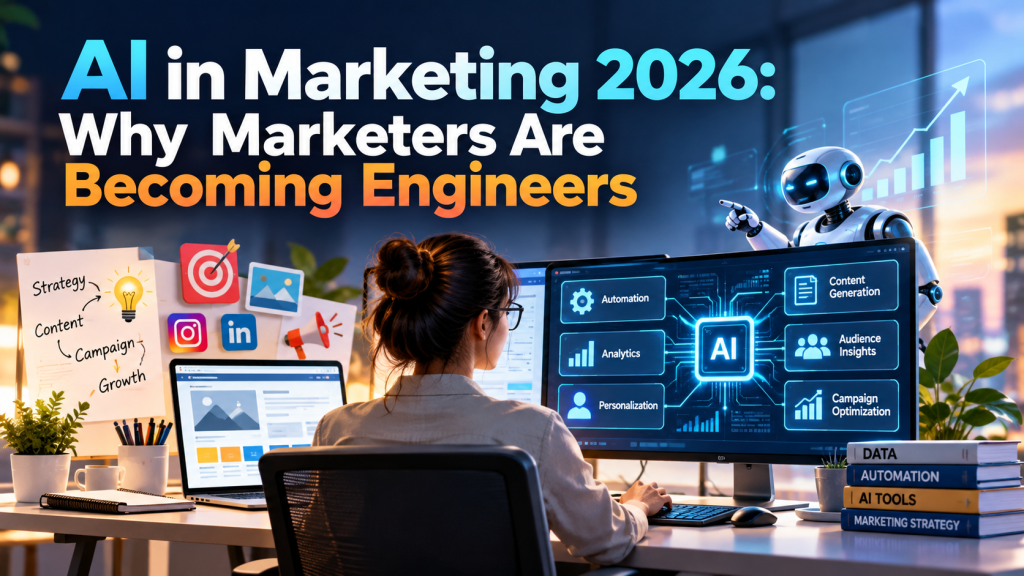
Ask a marketing team what changed most in the past two years, and many will skip the campaigns and talk about the plumbing: the prompts, the automations, the data connections and the agents that now draft, test and report. That shift is reshaping how teams hire, what job titles say and what employers expect from a marketer.
A Wall Street Journal CMO Today article, headlined “Marketers Are Rebranding as ‘Engineers’ to Survive the AI Era“, points to marketers adopting engineer-style titles as AI changes their work. This article uses that headline as a starting point, then asks two questions. Why is AI in marketing pulling the profession toward technical work? And is the “marketing engineer” a real new discipline or a new label on an existing job?
The short answer: the title is debatable, but the expectation behind it is real. Marketers are increasingly asked to understand data, automation and AI systems while keeping the strategic judgment that software cannot supply. For a wider view of the forces involved, see the major marketing trends reshaping the industry in 2026.
What Is a “Marketing Engineer”?
A marketing engineer is a marketer who builds systems as well as campaigns. They connect tools, write or configure automations, design AI workflows and use data to make those systems work. They do this in addition to understanding customers, positioning and messaging.
There is no standard definition. The term comes from industry usage rather than an official certification or a formal body of knowledge. One example is the AI-search company Profound, which describes marketing engineers as full-stack marketers with a builder’s skills who treat manual processes as systems to automate. Profound sells AI-visibility software, so read its framing as a vendor’s perspective.
Why Marketers Are Rebranding as Engineers in the AI Era
Several forces push in the same direction.
The tools now reward technical fluency. Generative AI, low-code automation and AI agents let a non-programmer build things that once required a developer. A marketer who can describe a workflow precisely can often get a working version running in an afternoon.
Workloads keep growing. Each new channel adds to the old ones, and teams cannot hire at the same pace. Automation is the obvious response, and someone has to design and maintain it.
Titles carry status. Skeptics argue the rebrand is partly about credibility. One marketer’s newsletter essay, “is everyone an engineer now?” argues that the tooling changed but the core logic of marketing did not, and that a new title may win a seat in rooms where “marketing manager” does not. That is commentary, not evidence, but it names a motive worth taking seriously.
Leaders describe a changing job. Klaviyo CMO Jamie Domenici, in an interview with The Agile Brand, described the move from running campaigns toward building workflows and managing agents rather than only people. That is one executive’s view, not an industry measurement.
How AI Is Changing the Marketing Profession
Adoption is widespread, but depth varies. In Salesforce’s 10th State of Marketing report, which Salesforce summarizes here, 75% of marketers said they use some form of AI. Only 13% were using agentic AI. The survey covered about 4,450 marketing decision-makers worldwide and ran in late 2025. Salesforce sells marketing software, and these figures measure usage, not business results.
The gap between those two numbers explains a lot about the current moment. Most teams use AI. Few have rebuilt their workflows around it.
Generative AI and content workflows
Generative AI drafts copy, summarizes research, produces image and video variations and repurposes one asset into many. The gain comes from the system around it: briefs, brand rules, review steps and publishing flows. A marketer who treats the model as a standalone writing assistant gets modest results. One who designs the whole workflow gets consistency and speed.
Quality control matters here. Marketers need to understand AI-generated content vs. human content for SEO in 2026 because the two behave differently in search. AI speeds up drafting, but original experience, accurate facts and a distinct point of view still separate useful pages from interchangeable ones. Google’s own guidance warns against mass-producing pages mainly to capture query variations, and an unsupervised content agent can do exactly that.
Data analysis, segmentation and personalization
AI tools can now answer plain-language questions about performance, flag anomalies and propose audience segments. That lowers the barrier to analysis, but it raises the importance of data quality. A model working from fragmented first-party data produces confident, unreliable answers. Marketers who understand CRM structures, tracking and consent are better placed to check what the system says.
Campaign optimization
Paid media platforms increasingly automate bidding, budgets and creative testing. The marketer’s job moves from adjusting settings by hand to setting goals, constraints and measurement, then judging whether the results reflect real incremental impact.
Search and AI search
Search now includes AI-generated answers alongside traditional results. Google’s documentation, AI features and your website, says specific optimization is not required for AI Overviews and AI Mode and that standard SEO fundamentals still apply. Many marketers use “AEO” (answer engine optimization) for the work of making content easy to find and cite. Treat it as an extension of SEO, not a replacement.
From Traditional Marketer to AI-Powered Marketing Professional
Responsibilities are shifting, not disappearing.
| Traditional marketing role | AI-era marketing role |
|---|---|
| Manual content production | AI-assisted content systems with human editing |
| Manual campaign analysis | Automated analytics with human interpretation |
| Basic segmentation | AI-assisted segmentation, validated against real data |
| Individual tool usage | Connected workflows across tools |
| Manual research | AI-assisted research and synthesis, with fact-checking |
| Campaign execution | Strategy plus workflow orchestration |
None of this makes traditional skills obsolete. Positioning, writing, audience understanding and budget judgment remain the foundation. The new layer sits on top of them.
What Skills Does a Marketing Engineer Need?
Skills fall into two groups, and the second group is what keeps the first one useful.
| Technical skills | Human and strategic skills |
|---|---|
| AI literacy: knowing what models do well and badly | Customer psychology and empathy |
| Prompting and instruction design | Brand and positioning strategy |
| AI workflow design | Content strategy and original ideas |
| Marketing automation and CRM knowledge | Critical thinking and skepticism toward outputs |
| APIs, integrations and no-code or low-code tools | Experimentation mindset |
| Analytics and data interpretation | Ethical judgment and risk assessment |
| SEO and AI-search optimization | Cross-team communication and leadership |
| Paid media operation | Business and commercial judgment |
The World Economic Forum’s Future of Jobs Report 2025 supports the broader pattern, though it is not specific to marketing. Based on a survey of more than 1,000 employers representing over 14 million workers in 55 economies, it expects AI and big data, networks and cybersecurity, and technological literacy to be the fastest-growing skills through 2030. It also finds analytical thinking is the most sought-after core skill, with seven in ten companies calling it essential. Those are employer expectations published in January 2025, not guarantees about any single job.
Prompting deserves a realistic note. It is useful, but it is a thin skill by itself. The durable version is closer to clear problem definition: stating the goal, the constraints, the inputs and what a good result looks like.
AI Agents and the Rise of Agentic Marketing
What AI agents are
An AI agent is software that pursues a goal across several steps, using tools and adjusting as it goes. A chatbot answers a prompt. An agent might review past campaign data, draft new ad variants, propose a budget split and check results each day, within permissions you set.
Salesforce’s research found only 13% of marketers using agentic AI, so most teams are early. This resource on how agentic AI and AI agents are changing digital marketing in 2026 breaks down the difference between rule-based automation, generative AI and agentic systems, along with practical use cases and risks.
Where agents fit
Plausible marketing uses include campaign monitoring, reporting, audience building, content routing, SEO monitoring and test prioritization. These tasks involve repeated, multi-step work with clear success measures.
Why oversight is non-negotiable
Agents can be confidently wrong, and mistakes can scale fast. Risks include inaccurate outputs, off-brand content, privacy and consent problems, biased targeting and unclear accountability. Practical safeguards include spend limits, approval steps for public or irreversible actions, audit trails and testing on low-risk workflows first.
Gartner’s caution is relevant. In a June 2025 press release, it predicted that over 40% of agentic AI projects will be canceled by the end of 2027 because of rising costs, unclear business value or inadequate risk controls. It also warned of “agent washing,” where vendors relabel existing chatbots and automation as agents. The forecast covers agentic AI across industries, not marketing alone, and it is a prediction rather than a measurement.
Is “Marketing Engineer” a Real New Profession or Just Rebranding?
The evidence supports a measured answer, not a verdict.
The case that it is real. Supporters say the work differs in kind. Building and maintaining automated systems, evaluating agent behavior and connecting data across tools are engineering-adjacent tasks. Marketers who do them are producing infrastructure that other teams rely on, and the old job description does not capture that.
The case that it is rebranding. Critics note that marketing operations, marketing technology and growth roles have involved technical work for years. They argue that a new title obscures how hard real engineering is, and that calling a skilled AI user an “engineer” overstates what one person can transform inside an organization. Some also say the label chases prestige more than precision.
What both sides agree on. The capabilities matter more than the title. Whether a company calls the role “marketing engineer,” “marketing operations lead” or “growth marketer,” the expectations are similar: understand the stack, design workflows, interpret data and know where automation must stop.
How AI Is Reshaping Marketing Jobs
The evidence points to changing responsibilities, not simple replacement.
Becoming more automated: first drafts, reporting, tagging, routine testing, basic segmentation, bid adjustments, research summaries and meeting notes.
Becoming more strategic: setting goals for automated systems, deciding what to test, interpreting ambiguous results, protecting brand consistency and managing risk.
Why interdisciplinary skills gain value: work that crosses marketing, data and technology is hard to hand off. A marketer who can talk to engineers, analysts and legal teams in their own terms saves time and catches problems earlier.
Salesforce’s survey data hints at the pressure involved. Most marketers use AI, yet many still run generic campaigns. Technology alone does not produce better marketing. Teams need people who can redesign how work gets done.
AI Marketing vs Human Marketing: What Still Requires Humans?
AI can accelerate or automate tasks. It cannot take accountability. Someone still has to answer for what a brand says, who it targets and what data it uses.
| Tasks AI can automate or accelerate | Tasks requiring human judgment |
|---|---|
| Drafting variations and first-pass copy | Positioning and brand voice |
| Summarizing research and reports | Deciding which insights matter |
| Segmenting audiences from data | Judging whether a segment is fair and appropriate |
| Monitoring campaign performance | Interpreting cause and effect |
| Running routine tests | Choosing what is worth testing |
| Scheduling and routing content | Cultural context and crisis response |
| Flagging anomalies | Ethical decisions and risk assessment |
| Producing options | Original ideas and business strategy |
Leadership, empathy for customers and the willingness to take a considered risk also stay with people. Original ideas remain scarce precisely because models are trained on what already exists.
How Marketers Can Prepare for the AI Era
Skip the motivational advice. These steps are practical and testable.
- Build AI literacy first. Learn what models do well, where they fail and how they produce confident errors. Use them daily on real tasks and check the outputs.
- Learn to specify problems. Practice writing precise instructions with context, constraints and examples. This transfers across tools.
- Strengthen analytics. Learn tracking, attribution limits and basic statistics so you can judge whether an AI summary is credible.
- Try one automation. Pick a repetitive task, such as weekly reporting, and automate it using no-code tools. Document what breaks.
- Practice agent supervision. Define permissions, approval points and a “what is the worst that could happen” test before any automated action touches live campaigns.
- Keep up with search changes. Learn how AI-driven search surfaces content, and keep the SEO fundamentals strong.
- Stay hands-on with paid media. Platforms are automating, but understanding what they optimize for is still an advantage.
- Run experiments. Treat AI changes as hypotheses and measure against a control.
- Learn the business. Understanding margins, sales cycles and customer economics makes you harder to replace than any tool skill.
The Future of Marketing in an AI-First Environment
Predictions about job counts and timelines are unreliable, so this section sticks to directions that current evidence supports.
- Smaller, more technical teams. Automation may let leaner teams cover more channels, though this depends heavily on data quality and governance.
- Cross-functional roles. Boundaries between marketing, data and product work are likely to blur.
- Human-plus-AI workflows. Automated execution with human strategic oversight appears to be the model most vendors and analysts describe.
- Integrated, measurable systems. Search, content, social and paid media are increasingly planned together. This guide to how SEO, AI search, social media and paid advertising are converging in 2026 explores that integration.
Gartner has also forecast that at least 15% of day-to-day work decisions will be made autonomously by agentic AI by 2028, up from effectively none in 2024. It is a cross-industry forecast and should be treated as an estimate.
Frequently Asked Questions
What is a marketing engineer?
A marketing engineer is a marketer who builds and manages systems, such as automations, AI workflows and data integrations, alongside traditional strategy and campaign work. The term is informal and has no official definition.
Why are marketers becoming more technical?
AI tools and low-code platforms make technical work accessible to marketers, while growing workloads push teams to automate. Employers also increasingly value data and technology skills.
How is AI changing marketing jobs?
AI is automating routine tasks like drafting, reporting and basic testing. Marketers spend more time on strategy, oversight, workflow design and interpreting results.
What skills does an AI-era marketer need?
Technical skills include AI literacy, prompting, analytics, automation, CRM knowledge and SEO or AI-search optimization. Human skills include customer insight, brand strategy, critical thinking and ethical judgment.
Will AI replace marketing jobs?
No reliable source supports a blanket claim. Evidence points to changing responsibilities, with automation taking routine tasks and human judgment staying essential. Specific roles may shrink or change, so ongoing upskilling matters.
What are AI agents in marketing?
They are software systems that pursue goals across multiple steps using connected tools, such as monitoring campaigns, building audiences or drafting content. Unlike a chatbot, they can act, which is why they need oversight.
Is prompt engineering important for marketers?
Yes, as part of a wider skill set. Clear instructions improve results, but workflow design, data quality and critical review matter more over time.
How can marketers prepare for AI-driven marketing?
Use AI daily on real tasks, strengthen analytics, automate one repetitive workflow, learn how AI search works and develop business strategy skills.
Conclusion
The headline question is whether marketers are becoming engineers or just changing their titles. The evidence supports a more useful conclusion: the title matters less than the expectation behind it. Marketers who work well in AI in marketing today understand data, automation, AI systems and workflow design, and they combine that with human judgment about brand, customers and risk.
Titles will keep shifting. Teams will keep rewarding people who can build reliable systems, check what machines produce and decide what is worth doing at all.