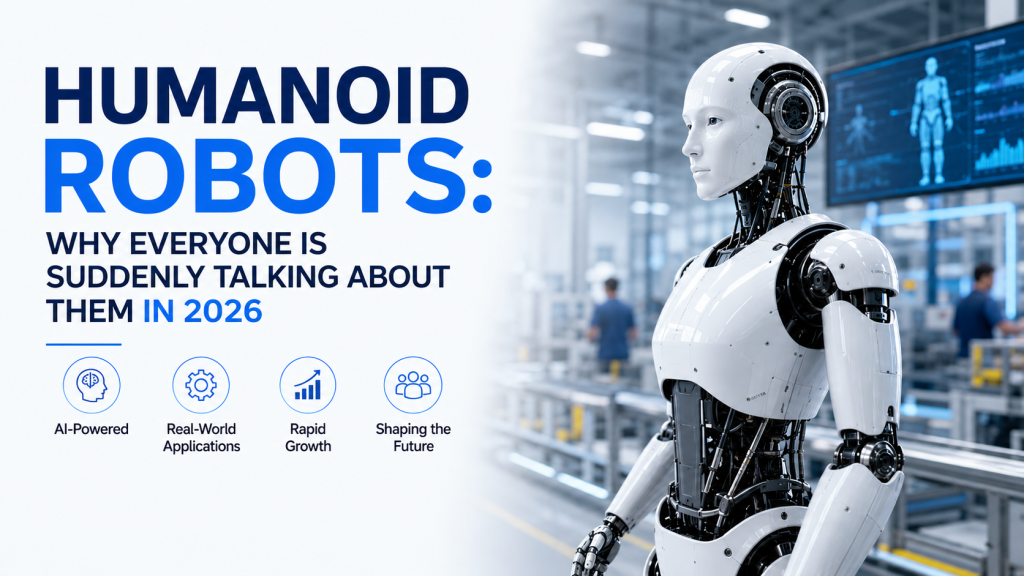
Humanoid Robots: Why Everyone Is Suddenly Talking About Them in 2026
A few years ago, humanoid robots were something you only saw in sci-fi movies or research lab demos. Today, they’re walking factory floors, delivering packages, and even running marathons. Yes — running marathons. So what changed? Let’s break it down.
What Exactly Is a Humanoid Robot?
A humanoid robot is a machine designed to look and move like a human — two arms, two legs, a head, and increasingly, human-like dexterity in its hands. But the real story in 2026 isn’t just the shape. It’s the brain behind it: AI models that let these robots see, reason, and adapt to unfamiliar environments instead of just following pre-programmed motions.
Why Is “Humanoid Robot” Trending Right Now?
The buzz isn’t hype anymore — it’s backed by real deployment numbers. As of August 2026, the sector is scaling fast: AgiBot has hit 15,000 cumulative units produced, Figure AI’s Figure 03 is now in production at one robot per hour and has crossed 1,000 total units, and Boston Dynamics’ Atlas deployments are moving forward. Add to that Tesla’s Optimus Gen 3 entering low-volume production ramp-up and Unitree targeting 10,000 to 20,000-plus shipments this year, and you can see why this isn’t a “someday” technology anymore — it’s happening now.
How Are Humanoid Robots Actually Being Used Today?
This is where it gets interesting. Robots aren’t just standing around in showrooms — they’re working:
- Automotive manufacturing: BMW has deployed wheeled humanoids from Hexagon Robotics at its Leipzig plant in Germany, and separately, Figure AI’s earlier F.02 robots helped BMW’s Spartanburg plant produce over 30,000 X3 vehicles and load more than 90,000 sheet metal parts before being retired for newer models.
- Logistics and warehousing: Agility Robotics signed a Robots-as-a-Service deal with Toyota Motor Manufacturing Canada in February 2026, placing seven Digit units on a RAV4 assembly floor in Woodstock, Ontario — marking the first commercial humanoid deployment in Canadian auto manufacturing.
- Hospitality and service: Dyna Robotics has rolled out humanoids in hotels, restaurants, laundromats, and gyms, where some units are already running 16 hours a day within months of deployment.
When Will You Actually Be Able to Buy One?
This is probably the question on everyone’s mind. According to industry trackers, entry-level full-size humanoids priced below $20,000 are expected between 2026 and 2027, with mass-market models projected to fall to the $10,000–$15,000 range by 2028–2030. So no, you can’t order one on Amazon yet — but the timeline is getting shorter every quarter.
What’s Driving the Recent Breakthroughs?
It’s not just bigger AI models — it’s hands. Literally. Much of this year’s dexterity breakthroughs have come from a new generation of robotic hand actuators. At CES 2026, a robot called RealHand demonstrated fine finger control by playing the piano live, made possible by a tiny, high-power motor for robot hands built by MinebeaMitsumi together with Harmonic Drive Systems. It sounds like a party trick, but that level of finger control is exactly what’s needed for tasks like sorting parts or handling fragile objects.
How Fast Can These Robots Really Move?
Fast enough to shock people. On April 19, 2026, Honor’s fully autonomous humanoid robot “Lightning” won the Beijing E-Town Half-Marathon in 50 minutes 26 seconds — beating the human world record by nearly 7 minutes. A few years ago, a robot falling over while walking was newsworthy. Now they’re setting speed records against elite human athletes.
Why Are Industries Adopting Humanoids Faster Than Expected?
There’s a simple economic logic here. Structured, high-volume commercial environments prove the reliability of the technology first, while more unpredictable domestic spaces are expected to follow only once enough real-world reliability data accumulates. In other words: factories and warehouses are the testing ground before robots ever reach your living room.
What Role Is AI Playing Behind the Scenes?
According to the International Federation of Robotics, AI-driven autonomy is one of the top trends reshaping the robotics industry, with different types of AI — including analytical AI that processes large datasets and detects patterns — increasingly used to make robots more independent. This shift toward autonomy is also raising the bar on safety. As robots increasingly work alongside humans in factories and service settings, ensuring safe operation has become essential, and AI-driven autonomy is fundamentally changing how that safety is tested and validated.
Is This Just a Fad, or Is It Really Going Mainstream?
Given the numbers — thousands of units already shipped, multi-year automotive contracts, real commercial deployments running double-digit hours per day — this looks less like a fad and more like the early stage of a genuine industrial shift. Major players like Tesla, Boston Dynamics, and Figure AI are focused on building general-purpose humanoid robots with significant funding and clear operational goals for mass production, and these robots are already being deployed across logistics, healthcare, hospitality, and retail.
How Big Is This Market Actually Getting?
Here’s where you have to be a little careful — analysts don’t all agree on exact numbers, and that’s worth being upfront about. One estimate puts the global humanoid robot market at around $3 billion in 2026, rising to $12 billion by 2030 and roughly $119 billion by 2040. Other firms are more conservative: BCC Research projects growth from $1.9 billion in 2025 to $11 billion by the end of 2030, while MarketsandMarkets puts 2025 value at $2.92 billion, reaching $15.26 billion by 2030 at a 39.2% annual growth rate. On the more aggressive end, ABI Research forecasts a market inflection point between 2026 and 2027, with annual shipments expected to hit 115,000 units by 2027 and 195,000 units by the end of the decade.
Zoom out far enough and the numbers get almost hard to believe. Morgan Stanley projects the humanoid robot market could reach $5 trillion by 2050, with more than 1 billion humanoid robots in use worldwide — roughly 90% of them for industrial and commercial purposes. Morgan Stanley’s own head of thematic research put it bluntly: it’s too early to declare a winner in the race for humanoid robot supremacy, and the U.S. will need real changes to manufacturing capacity, education, and policy to stay competitive.
The takeaway: nobody has a perfectly precise number, but every major analyst firm agrees on the direction — this market is compounding at 30–60% a year depending on which forecast you trust, and China in particular is investing heavily to lead it.
Who Are the Companies Actually Building These Robots?
A handful of names keep showing up, each taking a slightly different approach:
- Tesla (Optimus): Currently in a slow, low-volume production ramp at its Fremont factory, with output expected to increase gradually through the rest of 2026.
- Figure AI (Figure 03): Manufacturing at its BotQ facility at roughly one robot per hour, having passed 1,000 total units built. Figure AI deployed forty Figure 03 units at BMW’s Spartanburg plant in late June 2026, following an 11-month pilot of the earlier Figure 02 that helped produce more than 30,000 BMW X3 vehicles.
- Boston Dynamics (Atlas): Shifting from research demos to real commercial units, with initial electric Atlas units shipping to Hyundai’s RMAC unit and to Google DeepMind for further development.
- Agility Robotics (Digit): Digit is now working commercial shifts at Toyota Motor Manufacturing Canada’s Ontario facility and at a GXO Logistics warehouse in Flowery Branch, Georgia, and the company announced a merger with Churchill Capital Corp XI on June 24, 2026, valuing it at $2.5 billion.
- AgiBot and Unitree (China): AgiBot has scaled to 15,000 cumulative units produced, while Unitree — after 5,500-plus shipments in 2025 — is targeting 10,000 to 20,000-plus shipments in 2026 alone.
What’s Actually Stopping Humanoid Robots From Being Everywhere Right Now?
For all the exciting headlines, the honest picture includes some real, unglamorous engineering limits:
- Battery life is still short. Most humanoid robots can only operate for roughly 30 to 90 minutes before needing a recharge or human intervention, and current lithium-ion batteries generally limit active use to somewhere between 1 and 4 hours — a real problem for anyone hoping for 24/7 operation without a charging schedule.
- They’re expensive. Upfront costs for industrial humanoid units currently range from roughly $150,000 to $500,000, with payback periods projected to fall to 6–15 months by 2030 as operating costs potentially drop below $5 per hour under high-utilization conditions — but that’s a 2030 projection, not today’s reality.
- Cost is the top-cited barrier. A 2025 industry survey found that 73.4% of respondents named high implementation cost as the greatest barrier to adoption, with safety and reliability ranking second.
Is It Safe to Work Next to a Humanoid Robot?
This is a fair question to ask, and regulators are actively catching up. Manufacturers deploying humanoid robots must currently comply with standards including ANSI/RIA R15.08 for mobile manipulators and ISO 12100 for risk assessment, and a site-specific risk assessment is a regulatory requirement, not optional, before any robot operates alongside human workers. As of May 2026, OSHA has not published humanoid-robot-specific guidance, but its General Duty Clause still requires employers to keep the workplace free of recognized hazards.
The injury data so far is limited but real: an OSHA-linked analysis found 77 robot-related accidents between 2015 and 2022, resulting in 93 injuries, with most incidents occurring in collaborative zones that lacked adequate guarding. That’s across all robotics — not humanoids specifically — but it underlines why safety zoning and emergency-stop reliability are treated as non-negotiable in every serious deployment plan.
Will Humanoid Robots Take Your Job?
This is probably the most emotionally loaded question in the whole topic, so it’s worth answering carefully rather than dramatically.
The honest, current answer: it’s complicated, and precise numbers are mostly guesswork. No major study has produced a reliable humanoid-only job-loss figure — the widely cited statistics actually model broad automation trends generally, not humanoid robots specifically, so precise “X% of jobs by 2030” claims tend to overstate certainty that doesn’t exist yet.
What we do know:
- The World Economic Forum estimates that automation broadly could displace around 85 million jobs by 2030 while creating roughly 97 million new roles — figures cited slightly differently across WEF reports, but consistently pointing toward net job creation alongside real disruption.
- Logistics and automotive assembly are the leading humanoid deployment sites in 2026, both involving high-repetition physical tasks where the engineering case is now proven rather than theoretical — though current global deployment is still only in the hundreds to low thousands of units, small relative to the size of those labor forces.
- Sixty-one percent of manufacturing workers surveyed by Pew Research Center expressed concern about automation displacing their jobs, which is a legitimate and understandable reaction, not an overreaction.
- On the other side, IEEE survey respondents expect humanoids to eventually be accepted as ordinary co-workers within a decade, particularly as people experience benefits like reduced physical strain in healthcare and improved safety in factories.
The more grounded framing, echoed across multiple industry analyses, is that replacement is happening at the level of individual tasks rather than entire jobs — automating the parts of a role that are repetitive or physically taxing, while the human role shifts around what’s left.
What Happens Next?
IEEE Humanoids 2026, a 25th-anniversary conference convening December 6–9 in Santa Clara, has notably named labor displacement — not engineering capability — as its defining theme this year, which tells you something important: the technical question of “can robots do this?” is increasingly settled for a growing list of tasks. The harder, more human question — who gets displaced, who gets retrained, and who benefits — is now the one the industry itself says needs the most attention.
The Bottom Line
Humanoid robots have quietly crossed a line — from lab curiosity to working machines on real production floors, with thousands of units already shipped and multi-billion-dollar deals signed. But the full picture is more nuanced than viral robot videos suggest: battery life is still short, costs are still high, safety regulations are still catching up, and nobody can honestly tell you an exact number for how many jobs will change. What’s clear is the trajectory — every major analyst, from BCC Research to Morgan Stanley, agrees this technology is moving from prototype to production faster than almost anyone predicted even two years ago.