Introduction
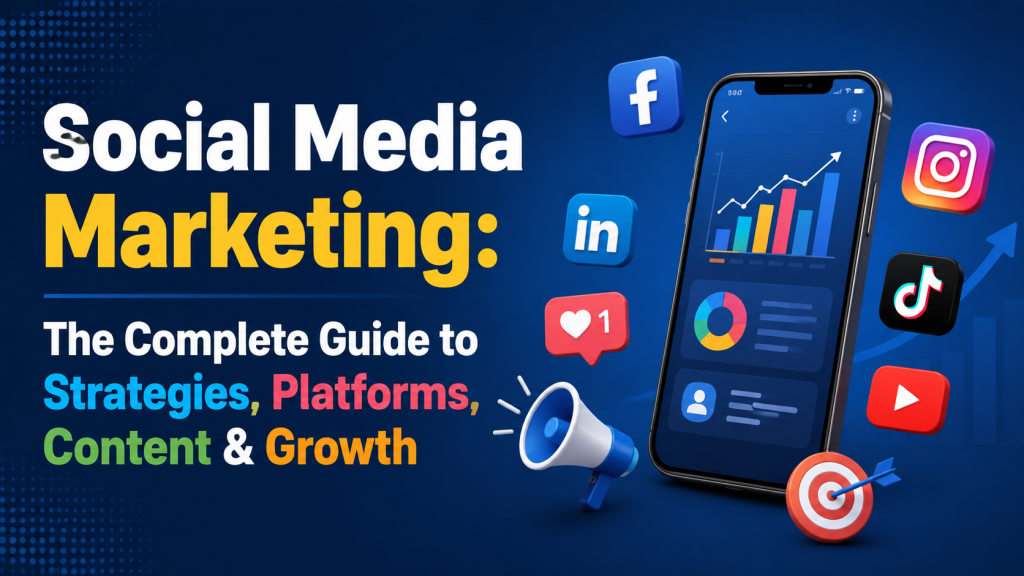
Social media has fundamentally changed the way businesses connect with their audiences. What began as a space for personal conversations has evolved into one of the most powerful commercial ecosystems on the planet. Today, brands don’t just advertise on social media — they build communities, drive sales, provide customer support, and tell stories that shape consumer perception.
Whether you’re a startup finding your first customers or an enterprise refining a multi-million-dollar campaign, mastering social media marketing is no longer optional — it’s a competitive necessity.
This complete guide walks you through everything you need to know: the core definitions, platform dynamics, content strategies, paid advertising, influencer marketing, analytics, and the trends shaping the future of social media marketing in 2026 and beyond.
What Is Social Media Marketing?
Social Media Marketing (SMM) is the practice of using social media platforms — such as Instagram, Facebook, TikTok, LinkedIn, YouTube, X (formerly Twitter), and Pinterest — to promote a brand, product, or service, engage with an audience, and achieve specific business goals.
Unlike traditional advertising, social media marketing thrives on two-way interaction. Brands don’t simply broadcast messages; they listen, respond, and co-create experiences with their communities. It encompasses a range of activities including:
- Creating and publishing organic content (posts, videos, Stories, Reels)
- Running paid social advertising campaigns
- Engaging with followers through comments, DMs, and community interactions
- Collaborating with influencers and creators
- Analyzing performance data to optimize strategy
- Managing brand reputation and customer service online
Why Is Social Media Marketing Important for Businesses?
The numbers speak for themselves. As of 2025, there are an estimated 5.24 billion social media users worldwide, representing approximately 64% of the global population. The average person actively uses or visits 6.84 different platforms per month and spends around 2 hours and 21 minutes per day on social media.
For businesses, this translates into enormous opportunity:
- Brand Awareness at Scale: Brands with an active presence across multiple social channels increase their reach by up to 4.2x compared to single-platform brands.
- Customer Acquisition: 83% of marketers say social media has become their primary customer acquisition channel.
- Revenue Impact: In 2025, sales through social platforms accounted for 17% of all online sales, a figure rising rapidly with social commerce integrations.
- Consumer Trust: 71% of consumers report that their purchasing choices are influenced by social media content and influencer recommendations.
- Customer Service Expectations: 76% of customers now expect companies to offer customer service via social media.
Social media marketing also delivers an unmatched ability to target specific demographics, measure campaign performance in real time, and iterate quickly based on data — advantages that traditional media simply cannot match.
Major Social Media Platforms for Marketing
Choosing the right platform is the foundation of any effective social media strategy. Each platform serves a unique audience and content format.
With over 3.56 billion daily active people as of Q1 2026, Facebook remains the world’s largest social network. It excels at community building, local business marketing, and highly targeted paid advertising. Facebook and YouTube are the top platforms consumers use for reading reviews (40% and 34%, respectively).
Instagram is the go-to platform for visual brands, lifestyle content, and influencer collaborations. With over 1.2 billion users interacting with Instagram Stories daily, it’s a powerhouse for product discovery. Studies show 67% of users aged 18–54 use Instagram to discover local businesses.
TikTok
TikTok dominates short-form video and viral discovery. The platform successfully converts 43.8% of users into buyers — significantly outperforming traditional display ads. TikTok leads platform investment priorities among marketers, with 19.3% of marketers planning to invest most in TikTok going forward.
LinkedIn is home to 1.3 billion members and is the undisputed leader for B2B marketing. It delivers strong ROI for professional services, SaaS companies, and recruitment. LinkedIn revenue grew 12% year-over-year as of Q3 FY2026, reflecting its commercial momentum.
YouTube
YouTube reaches 83% of U.S. adults, making it the most widely used video platform in the country. Its long-form and short-form (Shorts) content options suit education-driven brands, tutorials, product reviews, and entertainment content.
X (formerly Twitter)
About one-third of social media users hold X accounts. It remains valuable for real-time commentary, news-driven brands, thought leadership, and customer service interactions.
Pinterest is a discovery platform with a highly purchase-intent-driven user base. It’s particularly effective for fashion, home décor, food, and lifestyle brands looking to drive e-commerce traffic.
Threads
By Q3 2025, Threads reached 400 million monthly active users, and in January 2026 it surpassed X in daily mobile usage (141.5 million vs. 125 million DAUs). Despite this growth, only 12% of marketers currently use the platform — making it a high-opportunity, low-competition channel for brands that move early.
How to Create a Social Media Marketing Strategy
A social media marketing strategy is your blueprint — it defines your goals, audience, platforms, content approach, and measurement framework. Without a strategy, you’re posting on impulse and hoping something sticks.
Here’s a proven framework:
Step 1: Set SMART Goals
Define Specific, Measurable, Achievable, Relevant, and Time-bound goals. Examples: increase Instagram followers by 20% in 90 days; generate 500 leads per month via LinkedIn; achieve a 3% engagement rate on Facebook.
Step 2: Know Your Target Audience
Build detailed audience personas using demographics (age, location, income), psychographics (values, interests), and behavioral data (buying patterns, preferred platforms). Use native analytics tools like Meta Audience Insights and LinkedIn Analytics to validate your assumptions.
Step 3: Choose the Right Platforms
Focus on 2–3 platforms where your audience is most active. B2B companies typically get the strongest ROI from LinkedIn and YouTube, while D2C and consumer brands tend to thrive on Instagram, TikTok, and Pinterest.
Step 4: Conduct a Competitive Analysis
Analyze what your competitors post, how frequently they publish, which content performs best, and what platforms they prioritize. Identify content gaps you can own.
Step 5: Develop Your Content Plan
Decide on content pillars (the core themes you’ll cover), content formats (video, carousels, infographics, long-form posts), and posting frequency. Build a content calendar to maintain consistency.
Step 6: Establish Your Brand Voice
Define how your brand sounds and feels — whether that’s professional and authoritative, playful and humorous, or empathetic and community-driven. Consistency in tone builds recognition and trust.
Step 7: Measure, Analyze & Optimize
Track performance against your KPIs using platform analytics and third-party tools. Identify what’s working, double down on top performers, and cut what’s underperforming. The key to long-term success is continuous iteration.
Types of Social Media Content
High-performing social media programs use a diverse content mix. Here are the primary content types and when to use them:
- Short-Form Video (Reels, TikTok, Shorts): The dominant content format in 2026. Short-form video ads are the leading source of brand awareness for users aged 16 to 34 and deliver the highest engagement rates across most platforms.
- Carousels & Slideshows: Ideal for step-by-step tutorials, product showcases, and listicles. Instagram carousels consistently outperform single-image posts in reach and saves.
- Static Images & Graphics: Fast to produce and effective for announcements, quotes, and brand-forward visuals. Tools like Canva make high-quality design accessible for all team sizes.
- Long-Form Video: Best suited for YouTube, LinkedIn, and Facebook. Tutorials, webinars, and product deep-dives build authority and search discoverability.
- Stories & Ephemeral Content: 24-hour disappearing content drives urgency and behind-the-scenes authenticity on Instagram and Facebook.
- Live Video & Broadcasts: Live sessions generate real-time engagement, enable Q&As, and create a sense of community presence.
- Infographics: Highly shareable, especially on LinkedIn and Pinterest, for data-heavy or educational topics.
- Polls, Quizzes & Interactive Content: Drive engagement and surface audience insights simultaneously.
- User-Generated Content (UGC): Real customer content shared by the brand. UGC receives 8.7x higher engagement rates than branded content.
Social Media Content Strategy
A content strategy transforms isolated posts into a cohesive narrative that serves your audience and your business simultaneously.
The 80/20 Rule: Aim for 80% of your content to educate, entertain, or inspire your audience, and reserve 20% for direct promotional messaging. Audiences disengage when brands post too salesy.
Content Pillars: Define 3–5 core themes that align with your brand expertise and audience interests. A fitness brand might focus on: workout tips, nutrition advice, client transformation stories, product highlights, and community challenges.
Posting Frequency: Consistency matters more than volume. Use platform-native analytics to identify when your audience is most active and schedule accordingly. Accounts that reply consistently to comments see up to +42% higher engagement on Threads and +30% on LinkedIn.
Social SEO: In 2026, platforms increasingly function like search engines. Optimize your content with relevant keywords in captions, alt text, and hashtags so the right users can discover your content organically when searching for solutions, products, or ideas.
Organic vs. Paid Social Media Marketing
Understanding the distinction — and the interplay — between organic and paid social is critical for budget allocation and realistic expectation-setting.
Organic Social Media refers to all unpaid content you publish, including posts, Reels, Stories, and community engagement. It builds long-term brand equity, nurtures existing followers, and supports customer retention. The challenge: Facebook now shows brand posts to roughly 5% of followers organically, reflecting how algorithmic reach has declined across most platforms.
Paid Social Media involves investing in sponsored advertisements, boosted posts, influencer collaborations, and promoted content to reach targeted audiences beyond your existing followers. It offers precise targeting by demographics, interests, behavior, and lookalike audiences, making it highly measurable.
The best strategy integrates both. Organic content builds trust and community; paid amplification extends that content’s reach and drives direct conversions. Top-performing organic content that resonates with your audience also tends to convert better when boosted — so let data guide which posts deserve paid promotion.
Social Media Advertising
Paid social advertising has become a cornerstone of digital marketing budgets. Global social media ad spend is projected at approximately $276.7 billion in 2025 and is expected to grow at a compound annual growth rate (CAGR) of 11.71% between 2025 and 2030, reaching an estimated $480 billion by 2030.
Core Social Media Ad Formats
- Image & Video Ads: The most common format across all platforms, available in feed, story, and reel placements.
- Carousel Ads: Allow up to 10 images or videos in a single ad unit — effective for showcasing product ranges or telling multi-step stories.
- Lead Generation Ads: Native in-app forms (Meta Lead Ads, LinkedIn Lead Gen Forms) that capture contact details without requiring users to leave the platform.
- Shopping & Collection Ads: Enable in-feed product discovery and direct purchase, particularly powerful on Instagram and TikTok.
- Retargeting Ads: Re-engage users who visited your website, watched a video, or interacted with previous content. Consistently among the highest-ROI ad formats.
Key Advertising Principles
- Define clear campaign objectives (awareness, traffic, leads, conversions)
- Build highly specific audience segments rather than targeting broadly
- A/B test creative, copy, and calls-to-action continuously
- Monitor cost-per-result metrics and scale winning campaigns
- Use UTM parameters to track traffic and conversions in Google Analytics
Influencer Marketing and User-Generated Content
Influencer Marketing has evolved from a brand awareness tactic into a direct revenue channel. Influencer marketing generates up to $5.20–$5.78 for every dollar spent on average, with top-performing campaigns delivering $18–$20 per dollar — outperforming traditional digital advertising by up to 11x.
Types of Influencers
- Nano-influencers (1K–10K followers): Hyper-niche, highly trusted, exceptional engagement rates
- Micro-influencers (10K–100K): Deliver 60% higher engagement than mega-influencers while remaining cost-effective
- Macro-influencers (100K–1M): Broad reach with moderate engagement
- Mega-influencers & Celebrities (1M+): Maximum awareness, premium pricing, lower relative engagement
How to Run Effective Influencer Campaigns
- Align influencer values with your brand identity
- Prioritize engagement rate over follower count
- Use unique discount codes or affiliate links for trackable attribution
- Implement UTM parameters on all shared links
- Repurpose top-performing influencer content as paid ads
User-Generated Content (UGC)
UGC — real customers sharing authentic experiences with your products — builds trust no branded content can replicate. It receives 8.7x higher engagement than brand-created content and provides near-zero-cost creative assets for your channels. Encourage UGC through branded hashtag campaigns, contests, review requests, and community features.
Social Media Marketing Metrics & KPIs
Measuring the right metrics transforms social media from a creative exercise into a performance-driven business function. Here are the most important KPIs to track:
Awareness Metrics
- Reach: Total unique users who saw your content
- Impressions: Total times content was displayed (including repeat views)
- Share of Voice: Your brand’s presence relative to competitors in social conversations
Engagement Metrics
- Engagement Rate: (Likes + Comments + Shares + Saves) ÷ Reach × 100
- Video Completion Rate (VCR): Percentage of viewers who watch your video to the end — a strong signal of content relevance
- Saves & Bookmarks: A powerful signal of content value, especially on Instagram
Conversion Metrics
- Click-Through Rate (CTR): Percentage of users who click a link in your post or ad
- Conversion Rate: Percentage of social visitors who complete a desired action (purchase, sign-up, download)
- Customer Acquisition Cost (CAC): Total social spend ÷ Number of new customers acquired
- Return on Ad Spend (ROAS): Revenue generated ÷ Advertising cost
Retention & Loyalty Metrics
- Follower Growth Rate: Percentage increase in followers over time
- Customer Lifetime Value (CLV) of social-acquired customers: Often higher than other channels
- Sentiment Analysis: Qualitative measure of how audiences feel about your brand online
Best Social Media Marketing Tools
The right technology stack amplifies your team’s output and analytical depth. Here’s a categorized breakdown of the leading tools in 2026:
Social Media Management & Scheduling
- Hootsuite — Enterprise-grade scheduling, analytics, and team collaboration
- Buffer — Simple, effective scheduling with strong analytics for small-to-mid-size teams
- Sprout Social — Robust management platform with advanced CRM integration and social listening
- Later — Specializes in visual content scheduling, particularly for Instagram and Pinterest
Analytics & Social Listening
- Brandwatch — Industry-leading social listening and consumer intelligence platform
- Sprinklr — Enterprise social management with AI-powered insights
- Metricool — Accessible analytics and reporting for growing brands
AI-Powered Content Creation
- Canva — Highly practical for branded graphics, templates, presentations, and short videos
- Jasper — AI writing assistant for captions, ad copy, and blog content
- Adobe Firefly — Commercially safer AI image generation integrated with creative workflows
- Runway — AI-assisted video editing and generation for short-form content
Common Social Media Marketing Mistakes
Even experienced marketers fall into predictable traps. Avoid these common pitfalls:
- Posting Without a Strategy: Activity without intention produces noise, not results. Every post should serve a defined goal.
- Ignoring Analytics: Publishing content and never reviewing performance data means repeating mistakes indefinitely.
- Being on Too Many Platforms: Spreading resources thin across six platforms is less effective than excelling on two or three.
- Neglecting Community Engagement: Social media is a conversation. Brands that broadcast without responding lose audience trust and algorithmic favor.
- Inconsistent Brand Voice: Erratic tone and visual style undermine brand recognition and consumer confidence.
- Focusing Only on Vanity Metrics: Likes and follower counts feel good but rarely connect to revenue. Track metrics that tie to business outcomes.
- Ignoring Mobile Optimization: Over 80% of social ad revenue already comes from mobile. Every asset — images, videos, landing pages — must be designed mobile-first.
- Buying Followers or Engagement: Inflated numbers destroy credibility, distort your analytics, and can get your account penalized.
- Skipping Video Content: Most major platforms now algorithmically prioritize video. Brands that avoid it sacrifice organic reach.
- Treating All Platforms Identically: Repurposing the exact same content across all channels consistently underperforms platform-native content.
Social Media Marketing Best Practices
Build your approach on these foundational practices:
- Document your strategy: A written strategy keeps your team aligned and gives you a reference point when trends shift or algorithms change.
- Create platform-native content: Tailor format, tone, and messaging to each platform’s unique culture and audience expectations.
- Post consistently: Algorithmic platforms reward regular publishers with greater organic distribution.
- Engage in real time: Respond to comments and DMs promptly. Fast responses signal brand credibility and build community loyalty.
- Leverage social proof: Feature testimonials, case studies, reviews, and UGC to build trust with potential customers.
- Test relentlessly: Run A/B tests on creatives, headlines, posting times, and audiences. Let data drive decisions.
- Stay current with platform updates: Algorithms, ad formats, and best practices evolve constantly. Follow official platform blogs and industry reports.
- Integrate social with your overall marketing strategy: Social media should connect to your SEO, email, content marketing, and sales funnel — not operate in a silo.
Social Media Marketing for Different Types of Businesses
Social media strategy isn’t one-size-fits-all. Different business models demand different approaches.
B2B Companies
LinkedIn and YouTube are the highest-ROI platforms for B2B. Focus on thought leadership, case studies, webinars, and professional education content. LinkedIn delivers exceptional results for lead generation when paired with well-crafted long-form posts and targeted InMail campaigns.
B2C & E-Commerce Brands
Instagram, TikTok, and Pinterest drive product discovery and direct sales. Invest in Reels, influencer partnerships, and in-app shopping features. TikTok Shop and Instagram Shopping reduce friction between discovery and purchase.
Local & Small Businesses
Facebook and Google Business Profile (with social integrations) remain most effective for local visibility, reviews, and community engagement. Nextdoor is worth exploring for hyper-local targeting.
Personal Brands & Creators
Instagram, YouTube, TikTok, and LinkedIn (depending on niche) are optimal. Building an authentic, consistent personal brand drives audience loyalty that’s extremely difficult for larger brands to replicate.
Nonprofits
Facebook and Instagram are most effective for storytelling, fundraising, and volunteer recruitment. Authentic, mission-driven content paired with Meta’s nonprofit ad credits can drive significant results at low cost.
How to Measure the ROI of Social Media Marketing
Demonstrating social media ROI is the challenge most marketers cite as their greatest difficulty — but modern analytics tools have made it far more tractable. The average social media marketing ROI sits at roughly 3:1 across most industries, with B2B SaaS and service businesses often seeing higher returns due to recurring revenue models.
The ROI Formula
Social Media ROI = (Revenue from Social – Cost of Social Investment) ÷ Cost of Social Investment × 100
Practical Attribution Steps
- Set up UTM Parameters on every link you share — in bios, posts, and ads — to track traffic and conversions in Google Analytics.
- Use Meta’s Conversion API to track social touchpoints accurately, even post iOS privacy changes.
- Review Assisted Conversions in Google Analytics to understand how social media contributes to conversions that happen on other channels.
- Track Customer Lifetime Value (CLV) for social-acquired customers — they often exhibit higher brand loyalty and spend.
- Attribute revenue through unique promo codes for influencer and affiliate campaigns.
The 2025 Sprout Social Index found that 65% of business leaders want direct connections between social campaigns and business goals, and 52% want quantifiable cost savings attributed to social channels. Setting up the measurement infrastructure upfront is the only path to meeting those expectations.
Future of Social Media Marketing
Social media marketing is entering one of its most transformative eras yet. Here’s what’s shaping the next chapter:
AI-Powered Content at Scale
97% of marketing leaders now say AI literacy is mandatory for modern marketers. 67% of marketers already use AI tools to draft social content, with humans refining for brand voice and authenticity. The AI in social media market is projected to reach $70.53 billion by 2034 at a 37.11% CAGR. The brands that win will balance AI efficiency with human creativity and brand authenticity.
Social Commerce Dominance
Social commerce crossed the trillion-dollar threshold globally in 2026, transforming platforms from discovery channels into complete transaction ecosystems. In-app purchasing on Instagram, TikTok Shop, and Pinterest grew 45% year-over-year, and social commerce in the U.S. alone is projected to surpass $100 billion. For product-based businesses, this shift makes social media a direct revenue channel, not merely a branding tool.
Short-Form Video Supremacy
92% of marketers plan to spend the same or more on video marketing in 2026. The global digital video advertising market is expected to grow from $140 billion in 2025 to nearly $189 billion in 2026. Brands that build repeatable short-form video production pipelines will hold a durable competitive advantage.
Algorithm Shifts Toward Interest Graphs
Every major platform — Instagram, TikTok, LinkedIn, YouTube — has shifted distribution from social graphs (showing content from people you follow) toward interest graphs (showing content relevant to your interests regardless of source). This is both a challenge and an opportunity: content quality and relevance now matter far more than follower count.
Privacy-First Marketing
As third-party cookies disappear and privacy regulations tighten globally, marketers must shift toward first-party data strategies. Building owned audiences through email lists, community platforms, and CRM systems, fueled by social media, becomes increasingly valuable.
Creator Economy Expansion
The creator economy continues to professionalize and scale. Brands that build authentic, long-term creator partnerships — rather than one-off transactional deals — will increasingly outperform those relying on traditional advertising alone.
Conclusion
Social media marketing in 2026 is more sophisticated, more competitive, and more rewarding than ever before. The brands that win aren’t those that post the most — they’re the ones that post with purpose, engage with intention, measure with precision, and adapt with agility.
Whether you’re building your first social media strategy or scaling an established program, the principles remain constant: know your audience deeply, create content they genuinely value, choose platforms that align with your goals, and let data guide every major decision.
The future belongs to brands that treat social media as a true business system — one built on repeatable creative pipelines, authentic community relationships, and clear connections between social activity and business outcomes. Start building that system today.
Sources referenced in this article include Sprout Social, Hootsuite, HubSpot, eMarketer, Sprinklr, Meta Quarterly Reports, LinkedIn Earnings Reports, Influencer Marketing Hub, and the 2025 Sprout Social Index.