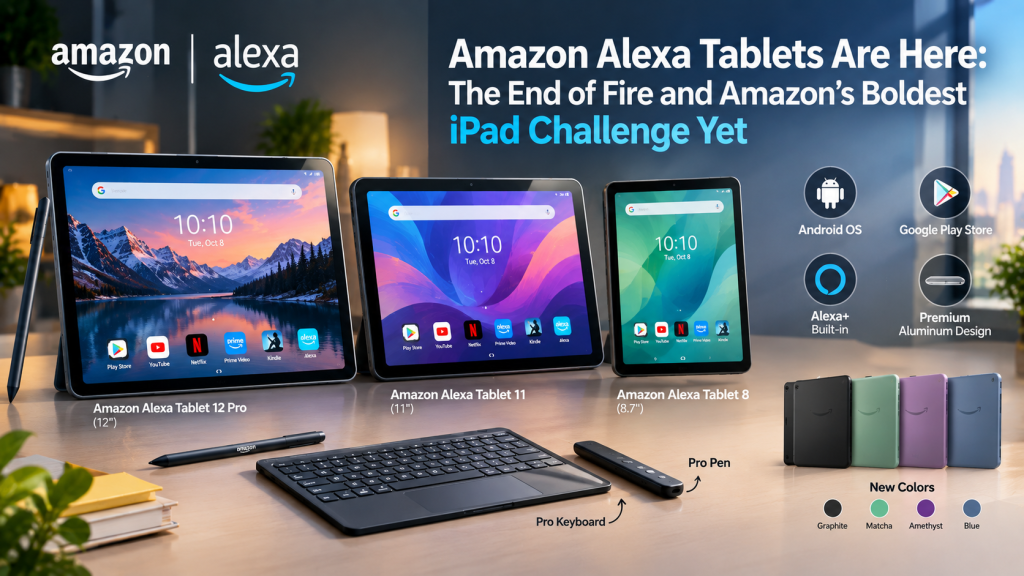
For more than a decade, the Amazon Fire tablet meant one thing: a cheap slab of plastic that did a few jobs well for very little money. It was great for streaming Prime Video, fine for kids, and a bit frustrating for everything else. On October 8, 2026, Amazon announced that era is over.
The company has introduced Amazon Alexa Tablets, a new three-model lineup that swaps Fire OS for Android, adds the full Google Play Store, builds in the Alexa+ AI assistant, and moves toward premium hardware and premium prices. Headlines say Amazon is “replacing” Fire, and in practice that’s what is happening. The budget brand is giving way to something much more ambitious.
This post covers what Amazon launched, what each model offers, what it costs, and whether it’s worth your attention.
What Amazon Actually Announced
The lineup has three models:
- Amazon Alexa Tablet 12 Pro, the flagship
- Amazon Alexa Tablet 11, the entertainment-focused middle model
- Amazon Alexa Tablet 8, the compact, portable option
All three use aluminum unibody construction, run Android, include Alexa+ at the core of the experience, and ship with the Google Play Store. Amazon’s own apps come preinstalled too: Prime Video, Kindle, Audible, Amazon Music, Amazon Quick and Amazon Luna.
Amazon told TechCrunch that these are a separate product line with new hardware and a new operating system, not renamed Fire tablets. That distinction matters. This is a reset, not a rebrand.
Why the Google Play Store Changes Everything
The biggest practical change is access to Google’s app ecosystem. Fire tablets always ran a heavily modified version of Android that relied on Amazon’s own Appstore. That meant missing apps, awkward workarounds and a constant sense of being second-class.
The new Alexa Tablets include full Google Play access from day one. You can install YouTube, Netflix, Gmail, Google Docs and millions of other apps without sideloading or hacks. For anyone who has fought with a Fire tablet to get a basic Google app running, this alone is a major upgrade.
It also signals a strategic shift. Amazon has stopped trying to build a walled garden around its tablets. It’s competing on hardware, AI and value rather than locking you into its own store.
Amazon Alexa Tablet 12 Pro: The Star of the Show
The 12 Pro is the device Amazon clearly wants everyone talking about. Here is what it offers:
- Display: 12 inches, 280 PPI, 120Hz refresh rate and a 3:2 aspect ratio
- Design: a single piece of aluminum, just 6.5mm thin
- Processor: a 4nm 8-core chip with up to 16GB of RAM
- Performance: nearly three times the processing power and nine times the graphics performance of any tablet Amazon has shipped before
- Audio: quad Dolby Atmos speakers
- Connectivity: Wi-Fi 6E
- Battery: up to 16 hours of video playback, the longest Amazon has offered on a tablet
Pricing: the standard 12 Pro starts at $499.99 with 8GB of RAM and 128GB of storage. The Nanomatte version starts at $549.99.
The Nanomatte Display
The most interesting hardware detail is the Nanomatte screen. Amazon worked with Corning on a photolithography process that etches a precise texture into the glass at the sub-pixel level. Conventional matte screens roughen the surface in a less controlled way, which can scatter light and soften the image. Amazon says its approach cuts glare while keeping detail and color accuracy intact. Early hands-on coverage has singled out the display as a highlight.
The matte surface also gives the screen a slight friction that Amazon says makes writing feel closer to pen on paper. That brings us to the accessories.
Pro Pen and Pro Keyboard
The 12 Pro is designed to double as a work device, and two accessories make that possible:
- Alexa Tablet Pro Pen ($89.99): a USI 2.0 active pen with 4,096 pressure levels, tilt detection, magnetic docking and wireless charging
- Alexa Tablet Pro Keyboard ($149.99): attaches magnetically with no Bluetooth pairing and supports multi-window productivity
Amazon says you can run email, Slack and other apps side by side and switch between work and personal profiles. Together, the accessories make the 12 Pro a credible alternative for note-taking, PDF markup, light editing and everyday office work.
Alexa Tablet 11 and Alexa Tablet 8
Not everyone needs a flagship, and Amazon has made sure the other two models don’t feel like afterthoughts.
Alexa Tablet 11 (from $329.99)
- 11-inch 2.5K display at 276 PPI with 90Hz scrolling
- 16:10 cinematic aspect ratio
- 8-core processor with 8GB of RAM and 64GB of storage
- Dual Dolby Atmos speakers
- Up to 15 hours of video playback
- Colors: Graphite, Amethyst and Matcha
Alexa Tablet 8 (from $229.99)
- 8.7-inch display in an all-aluminum body
- Weighs just 329g and measures 7.95mm thin
- 8-core processor with 4GB of RAM and 64GB of storage
- Wi-Fi 6 and up to 14 hours of video playback
- Colors: Graphite, Rosette and Teal
The Tablet 11 suits streaming, gaming and browsing, while the Tablet 8 is the one-handed reading and travel companion.
Alexa+ Is Built Into the Core
The name isn’t decoration. Alexa+ is central to how these tablets work. You can say “Alexa” or tap the “Ask Alexa” button, and the assistant appears without pulling you out of the app you’re in.
Two features stand out:
On-Screen Intelligence. Alexa can look at what’s on your screen and help in context. Amazon’s example is browsing hiking trails and asking which one suits you best, or pulling up a game schedule and asking Alexa to add every date to your calendar and flag conflicts.
Live sessions. These start a continuous, hands-free conversation with no wake word needed between questions. If you’ve enabled On-Screen Intelligence, you can also share your screen so Alexa follows along as things change, such as spotting a recipe and pulling out the key details.
On privacy, Amazon says every On-Screen Intelligence feature is off by default and needs a deliberate opt-in, with a visible indicator whenever Alexa is active. As with any AI feature that can see your screen, it’s worth reviewing the settings carefully before switching it on.
The tablets also include a personalized “For You” feed that combines what you’ve watched, read, listened to and played, plus a Dynamic Tab on the home screen that surfaces what’s useful.
A Kindle Sanctuary on a Tablet
One of the nicer touches is a dedicated reading mode. Open a book in the Kindle app and the tablet silences notifications, reduces blue light and stretches battery life to as much as 20 hours. Three display themes (warm natural color, soft paper tone and pure grayscale) let you pick your look.
Notes and highlights made with the Pro Pen sync across Kindle apps on pen-supported devices and with Kindle Scribe. Some early reviewers have called the 12 Pro a possible Kindle alternative, particularly with the Nanomatte screen.
New Amazon Kids Tablets
Amazon also announced redesigned Kids Tablets in 8.7-inch and 11-inch sizes. Each bundle includes the device, a kid-proof case and a year of Amazon Kids+. Younger children (3+) get a soft bumper case, with designs from franchises like Paw Patrol and Barbie, while kids 6 and up get a slim hard case with a built-in kickstand. Kids+ adds a tool called Storybuilder, which lets children use their voice to create illustrated stories, and a redesigned Parent Dashboard gives weekly insight into what kids are exploring.
The Price Hike Question
The word “premium” is doing a lot of work here. Reuters framed the launch as Amazon raising prices alongside its first Android tablets, and that’s fair. Fire tablets built their reputation on being very cheap. Starting at $229.99, the new lineup is a clear step up.
The counterargument is that you now get far better hardware, a proper app store and a modern AI assistant. Several early reviews have pitched the 12 Pro as an “iPad Pro experience” at roughly half the price. That’s a reviewer’s framing rather than a like-for-like comparison, and an iPad still has advantages in ecosystem depth and accessories. But Amazon is clearly aiming at the premium end rather than the bargain bin.
Availability and Launch Dates
- October 14, 2026: US, Mexico and Canada (Kids Tablets also arrive in Japan)
- October 19, 2026: UK, Germany, France, Italy and Spain
You can buy directly from Amazon, and select retailers including Best Buy and Target will carry them in the US. The launch details don’t mention India, so if you’re in India, keep an eye on Amazon’s announcements for any regional rollout.
Who Should Buy One?
Buy the 12 Pro if you want one device for streaming, reading and light productivity, and you value a glare-free screen and pen support. Remember to budget for the keyboard and pen if you want the full workstation experience, since they add $239.98 together.
Buy the Tablet 11 if your main use is entertainment: streaming, gaming and browsing on a larger screen at a friendlier price.
Buy the Tablet 8 if portability matters most, especially for reading and commuting.
Consider waiting if you’re deeply invested in Apple’s ecosystem, or you want independent long-term reviews first. These devices only go on sale on October 14, so real-world battery, software support and Alexa+ performance are still to be proven.
The Bottom Line
Amazon Alexa Tablets mark the biggest shift in Amazon’s tablet strategy since the original Fire. By moving to Android, adding the Google Play Store and putting Alexa+ at the center, Amazon has removed the biggest reasons people avoided its tablets, while raising the price of admission. Whether it can pull shoppers away from the iPad and Samsung’s Galaxy Tab range will depend on how these devices perform once they reach customers.
For now, one thing is clear: the Fire tablet is gone, and Amazon is making a serious bid for the premium tablet market.