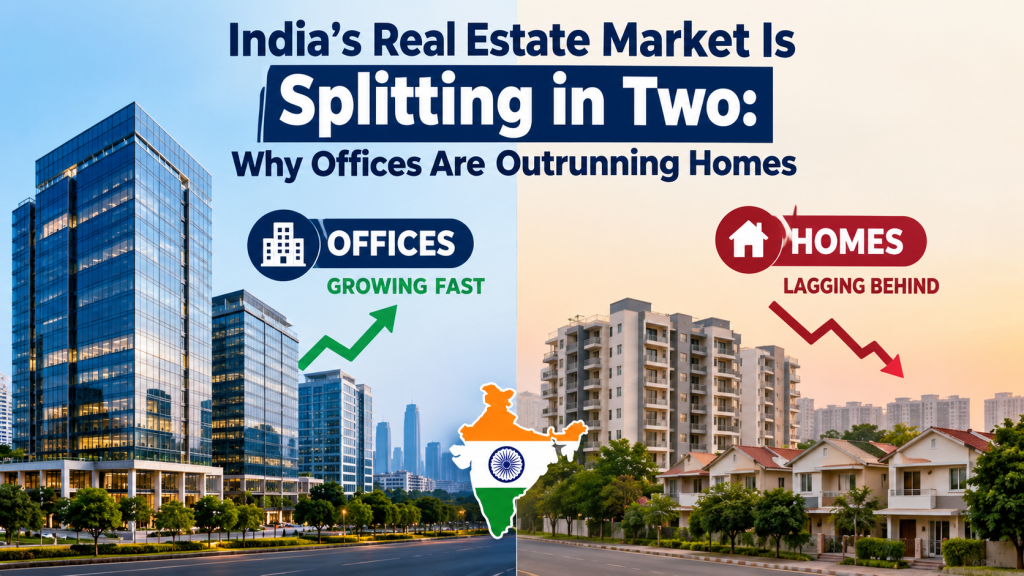
India’s property market is no longer moving as one block. For years, “real estate” meant a single story of rising prices, new launches and festive-season bookings. Today there are two stories running side by side. Commercial real estate, meaning offices, flex spaces and leased business premises, is expanding steadily on strong corporate demand. Residential real estate is catching its breath after a long sprint.
This split matters whether you are a homebuyer deciding when to commit, an investor choosing between a flat and a leased office, or a professional watching where the jobs and the construction cranes are heading. Here is what is driving the divergence and how to read it.
Two Segments, Two Different Engines
The easiest way to understand the split is to look at what powers each side.
Residential demand is driven by households. It depends on incomes, interest rates, job security, family formation, and, above all, affordability. When prices rise faster than salaries, buyers hesitate no matter how attractive the project looks.
Commercial demand is driven by businesses. It depends on hiring plans, expansion budgets, global outsourcing trends, and how companies want their employees to work. A multinational setting up a new technology centre in an Indian city does not care much about a home loan rate. It cares about talent, connectivity and the quality of the building.
So the two segments can move in opposite directions even when the broader economy is healthy, and that is what we are seeing now.
What the Numbers Say
Crisil Intelligence gives a useful snapshot. In its outlook for the current fiscal, residential demand in India’s top seven cities is expected to ease by 2–4 per cent because of a high base effect, even as premiumisation continues. The same report projects that commercial demand will rise 5–7 per cent while supply grows 9–11 per cent, fuelled by leasing from global capability centres, flexible workspace operators and the IT/ITeS and BFSI sectors.
The residential slowdown is not a collapse. It follows robust growth over FY22–FY24, and Crisil links the easing to sharp price appreciation and city-specific factors such as higher stamp duty and registration charges. In other words, the housing market is cooling after running hot, not falling off a cliff.
Crisil also expects the picture to brighten. It sees a more optimistic outlook for fiscal 2027, with recovery driven by rising incomes, lower interest rates and continued infrastructure improvements. It cautions, however, that commercial momentum may ease next fiscal because of the high base built over the past four to five years.
Why Offices Are Winning Right Now
1. Global capability centres are hungry for space
Global capability centres (GCCs) are in-house technology, analytics, finance, and engineering hubs that multinational companies set up in India. They have become a major source of office leasing. India offers a deep pool of skilled graduates at competitive cost, and companies are moving beyond back-office support to run core functions from their Indian centres. Each new centre means hundreds or thousands of seats, and that translates directly into leased square footage.
2. Demand is broadening beyond IT
Technology firms were once the automatic answer to “who is leasing offices?” That has changed. Crisil’s data shows office demand spread across banking and financial services, engineering and manufacturing, and consulting. Around 25 million sq ft of conventional space, or 40 per cent of uptake, came from BFSI, engineering and manufacturing, and consulting firms in 2025. A market that depends on several sectors is far more resilient than one that depends on a single industry.
3. Flexible workspaces are changing how companies lease
Startups, mid-sized firms and even large corporations now use managed and co-working spaces to add capacity quickly without long commitments. Flex operators take large blocks from landlords and sublet them in smaller units, which keeps demand for large floor plates steady.
4. Quality is beating quantity
Occupiers increasingly want well-located, amenity-rich, certified buildings close to metro lines and talent pools. Landlords with premium assets have pricing power, while older, poorly located stock struggles. If you want a closer look at this shift, our piece on why India’s commercial real estate market is betting big on quality over quantity in H2 2026 covers how landlords and tenants are adjusting.
Why Housing Is Taking a Breather
Prices have climbed faster than comfort levels
The biggest brake on housing is simple: homes have become expensive. Prices per square foot have risen steadily in most major cities, and even buyers with healthy incomes are stretching their budgets. Many are waiting, downsizing their expectations or shifting to a different micro-market. We explored this in detail in Why Your Dream Home Just Got More Expensive, which looks at what is pushing prices up and who feels it most.
The base effect is real
When a market posts strong years in a row, even healthy sales look weak by comparison. Part of the “slowdown” in housing is statistical. Compared with a record stretch, a merely good year looks like a dip. That does not mean demand has vanished, only that the extraordinary pace could not last forever.
Local costs add friction
Stamp duty, registration charges and local levies vary by city and can change the cost of buying noticeably. Where these costs rise, buyers often delay decisions or look at neighbouring markets.
Premiumisation is reshaping the mix
Even as overall volumes ease, buyers who do commit are increasingly choosing larger, better-equipped homes in well-planned projects. Developers have responded by launching more premium and luxury inventory. This lifts average ticket sizes but can leave entry-level and mid-income buyers feeling underserved.
Money Is Following the Momentum
The split is visible in capital flows too. Institutional investors, including global funds, pension investors and REIT-focused capital, generally prefer income-producing assets with predictable rental yields. Leased office buildings fit that description far better than individual apartments.
That helps explain why large investors have been so active in the sector. The scale of that interest was clear in recent data on record quarterly capital inflows into Indian real estate. Where institutional money goes, it tends to bring better governance, more professional management and more development activity.
What This Means for Different Readers
If you are a homebuyer
A cooling market can work in your favour. With demand easing, you may find more room to negotiate, better payment plans and more choice. But “cooling” does not mean “cheap.” Focus on what you can comfortably afford, the developer’s delivery record and RERA registration, and avoid rushing because of artificial deadlines. If interest rates drift lower as Crisil’s outlook suggests, waiting a little may improve your loan economics, though no one can time the market precisely.
If you are an investor
Commercial assets offer a different risk and return profile. Rental yields are usually higher than in residential property, lease terms are longer and tenants are corporates rather than individuals. The trade-offs are higher entry costs, vacancy risk and dependence on a few large tenants. Fractional ownership platforms and listed REITs have lowered the barrier for smaller investors, but they require careful reading of the underlying assets, tenant quality and fees.
If you are a developer
The message is to match the product to the demand. Developers with strong commercial portfolios are benefiting right now, while those focused only on residential must manage inventory carefully and price realistically. The winners will likely be those who diversify across segments and prioritise quality.
If you are a working professional
The strength of office leasing signals continued hiring in technology, finance and consulting hubs. It also raises a practical question: where should you live? Proximity to major business districts can shape rental demand and price growth for nearby housing over time, so the two segments are connected even as they diverge.
Risks to Watch
A split market is not a risk-free market. Several things could change the picture:
- Oversupply in offices. With commercial supply projected to grow slightly faster than demand, some micro-markets could see rising vacancies if new space arrives faster than tenants.
- Shifts in work culture. Hybrid and remote work have not killed office demand, but they have changed how much space each employee needs.
- Global slowdowns. Because GCC and IT leasing depend on international business conditions, a sharp global downturn could slow hiring and expansion.
- Interest rate surprises. Housing demand is highly sensitive to borrowing costs. A slower-than-expected fall in rates could extend the residential pause.
- Affordability fatigue. If incomes do not keep pace with prices, the housing slowdown could last longer than the base-effect explanation suggests.
The Bigger Picture
Look past the headline contrast and the long-term story is still constructive. India has a large housing shortfall, a young and urbanising population, rising incomes and a steady flow of global business into its cities. Crisil’s own conclusion is that the long-term outlook for Indian real estate remains positive, with growth and stability expected to return in the medium term.
The near-term divergence is best read as a rebalancing. Offices are benefiting from a surge in corporate and global demand. Homes are digesting years of price growth. Neither trend is permanent, and the leaders of one cycle often become the laggards of the next.
Final Takeaway
India’s real estate market is now a story of two speeds. Commercial property is advancing on strong leasing from global capability centres, flexible workspace operators and a widening set of industries. Housing is moderating after a powerful run, held back by high prices, higher transaction costs and a tough comparison with earlier years.
For buyers, investors and developers alike, the smart move is to stop thinking of “the market” as one thing. Understand which segment you are dealing with, what drives it, and where it sits in its cycle. Decisions made with that clarity will serve you better than those made on headlines alone.
Disclaimer: This article is for informational purposes only and is not financial or investment advice. Please consult a qualified professional before making property decisions.