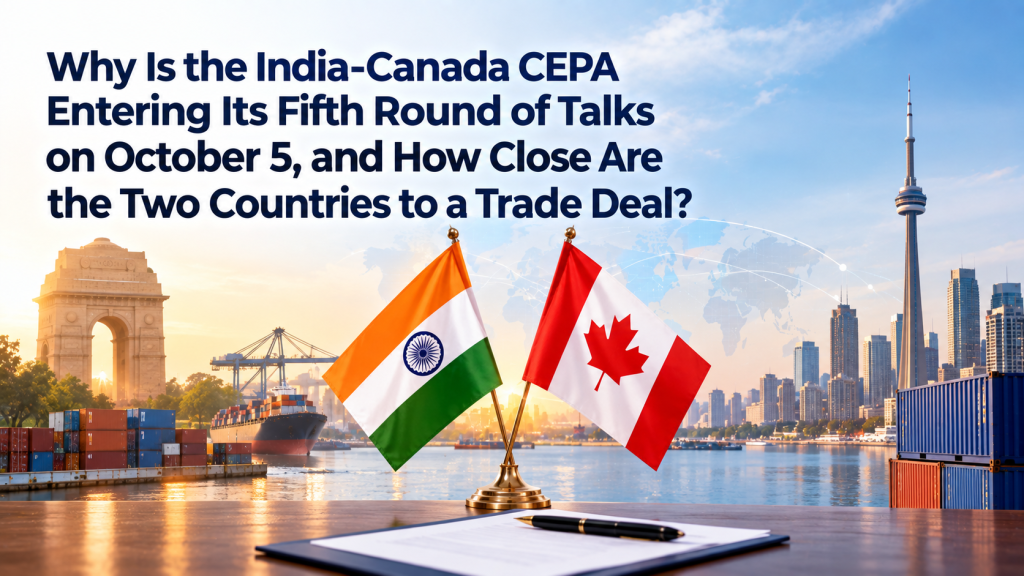
Two countries that spent much of the last three years barely speaking to each other diplomatically are now racing toward a trade deal on a 90-day clock. That’s the quiet irony sitting underneath the India-Canada Comprehensive Economic Partnership Agreement, or CEPA, as it enters its fifth round of negotiations on October 5 in Ottawa.
Commerce and Industry Minister Piyush Goyal confirmed the date himself, telling reporters that both sides have resolved to fast-track negotiations following the conclusion of the fourth round in New Delhi on September 18. His framing of what comes next was blunt: the next 90 days should be a very defining period in the Canada-India relationship.
This piece breaks down what’s actually on the table, why the pace has suddenly picked up, and how close a deal really is — and how it connects to the wider new FTAs that are giving investors comfort to invest in India’s global supply chains.
A Relationship That Had to Be Rebuilt Before It Could Be Negotiated
To understand why this round matters, it helps to remember where CEPA talks stood before. The broader Canada-India Free Trade Agreement framework had been stalled for years, and CEPA negotiations themselves were effectively suspended amid a period of strained diplomatic relations between the two countries.
The thaw came from the top. Prime Minister Modi and Canadian Prime Minister Mark Carney agreed in November 2025 to formally restart CEPA negotiations, and the pace since then has been unusually quick by trade-negotiation standards — two rounds completed by May 2026, a third hosted by Canada, a fourth wrapping up in Mumbai and New Delhi in September, and now a fifth beginning October 5 in Ottawa.
That speed itself is a signal. Trade deals that drag on for a decade usually do so because political will is missing on one side or both. A negotiation moving through five rounds in under a year suggests both governments have decided this deal is a priority worth pushing through quickly, echoing the same urgency behind India’s renewed push for trade talks with China to address imbalance and supply chain concerns.
What’s Actually on the Table
The fifth round isn’t just a procedural formality — it’s expected to tackle some of the harder, more contested chapters of the agreement. Canadian International Trade Minister Maninder Sidhu has said this round will focus specifically on resolving trade differences, following his meeting with Goyal in Mumbai during the fourth round.
The scope of what CEPA is meant to cover has also expanded as talks have progressed. Beyond traditional goods and services market access, the agreement is now expected to unlock cooperation in critical minerals, clean energy, technology, and advanced manufacturing, alongside the sectors negotiators have long flagged as strategic priorities: pharmaceuticals, IT services, and agriculture.
Critical minerals, in particular, deserve attention here. Canada holds some of the world’s largest reserves of minerals essential to batteries, electronics, and clean-energy manufacturing — exactly the kind of inputs India needs as it scales up Make for India’s shift toward owning components and design, not just assembly, including electronics, EV, and semiconductor production domestically.
The Number Both Sides Keep Repeating
Every official statement around this negotiation circles back to one figure: bilateral trade is targeted to roughly double, from $30.4 billion in 2025 to $70 billion by 2030. That target was set by ministers committed to concluding CEPA by the end of 2026, and it’s being used as the shorthand justification for why both governments are moving so fast.
Whether that number is realistic depends entirely on what gets resolved in rounds five and beyond. Doubling trade in under four years requires removing real barriers, not just signing a symbolic framework.
How Close Is a Deal, Really?
Here’s where some caution is warranted. Every official statement points toward optimism, and Canadian Prime Minister Mark Carney has publicly said talks are making good progress, with a deal targeted around the G20 timeline. But optimism and a signed agreement are two different things, and “resolving trade differences” — the explicit goal for this round — is usually where negotiations slow down, not speed up.
The practical signals worth watching over the next few months:
- Whether round five in Ottawa produces visible progress on market access and tariff schedules, or mostly procedural agreement on structure
- Whether the critical minerals and clean energy chapters, which are newer additions to the talks, get resolved as quickly as the more established goods and services chapters
- Whether the year-end target holds, or quietly slips the way many “ambitious” trade deadlines do
- Whether domestic political pressures in either country, particularly around agriculture or dairy market access, resurface as sticking points
Why This Deal Matters Beyond the Two Countries Involved
A finalised CEPA would arrive at a moment when Indian exporters are watching their trade terms with other partners get genuinely complicated, particularly the live uncertainty around US tariff law and its effect on Indian exporters, which is already affecting how exporters plan shipments and pricing.
Set against that backdrop, a finalised CEPA becomes more than a bilateral trade story — it’s one more data point in how India is diversifying its trade relationships through multiple simultaneous channels, a strategy that also showed up clearly in India’s push at the BRICS Summit to steer the bloc toward deeper economic integration.
What to Watch Next
The fifth round beginning October 5 in Ottawa is likely to be more revealing than the four rounds before it, precisely because it’s tasked with resolving actual disagreements rather than building structural groundwork. If both sides emerge from Ottawa with real movement on market access and the newer critical minerals and clean energy chapters, the year-end target starts to look achievable. If the round ends with another round of “constructive discussions” language but no concrete resolution, the 90-day defining period Goyal described may turn out to define a delay rather than a deal.
The Bottom Line
India and Canada have moved from a stalled, politically strained trade relationship to five negotiation rounds in under a year, a pace that reflects genuine intent on both sides. The fifth round starting October 5 is where that intent gets tested against the harder, unresolved parts of the agreement: market access, critical minerals, and the sensitive sectors that have derailed past negotiations. A deal by year-end is plausible, but not yet guaranteed, and the next 90 days will likely decide which way it goes.
For more on India’s expanding trade relationships and manufacturing strategy, explore our Manufacturing category.
A Relationship That Had to Be Rebuilt Before It Could Be Negotiated
To understand why this round matters, it helps to remember where CEPA talks stood before. The broader Canada-India Free Trade Agreement framework had been stalled for years, and CEPA negotiations themselves were effectively suspended amid a period of strained diplomatic relations between the two countries.
The thaw came from the top. Prime Minister Modi and Canadian Prime Minister Mark Carney agreed in November 2025 to formally restart CEPA negotiations, and the pace since then has been unusually quick by trade-negotiation standards — two rounds completed by May 2026, a third hosted by Canada, a fourth wrapping up in Mumbai and New Delhi in September, and now a fifth beginning October 5 in Ottawa.
That speed itself is a signal. Trade deals that drag on for a decade usually do so because political will is missing on one side or both. A negotiation moving through five rounds in under a year suggests both governments have decided this deal is a priority worth pushing through quickly, echoing the same urgency behind India’s renewed push for trade talks with China to address imbalance and supply chain concerns.
What’s Actually on the Table
The fifth round isn’t just a procedural formality — it’s expected to tackle some of the harder, more contested chapters of the agreement. Canadian International Trade Minister Maninder Sidhu has said this round will focus specifically on resolving trade differences, following his meeting with Goyal in Mumbai during the fourth round.
The scope of what CEPA is meant to cover has also expanded as talks have progressed. Beyond traditional goods and services market access, the agreement is now expected to unlock cooperation in critical minerals, clean energy, technology, and advanced manufacturing, alongside the sectors negotiators have long flagged as strategic priorities: pharmaceuticals, IT services, and agriculture.
Critical minerals, in particular, deserve attention here. Canada holds some of the world’s largest reserves of minerals essential to batteries, electronics, and clean-energy manufacturing — exactly the kind of inputs India needs as it scales up Make for India’s shift toward owning components and design, not just assembly, including electronics, EV, and semiconductor production domestically.
The Number Both Sides Keep Repeating
Every official statement around this negotiation circles back to one figure: bilateral trade is targeted to roughly double, from $30.4 billion in 2025 to $70 billion by 2030. That target was set by ministers committed to concluding CEPA by the end of 2026, and it’s being used as the shorthand justification for why both governments are moving so fast.
Whether that number is realistic depends entirely on what gets resolved in rounds five and beyond. Doubling trade in under four years requires removing real barriers, not just signing a symbolic framework.
How Close Is a Deal, Really?
Here’s where some caution is warranted. Every official statement points toward optimism, and Canadian Prime Minister Mark Carney has publicly said talks are making good progress, with a deal targeted around the G20 timeline. But optimism and a signed agreement are two different things, and “resolving trade differences” — the explicit goal for this round — is usually where negotiations slow down, not speed up.
The practical signals worth watching over the next few months:
- Whether round five in Ottawa produces visible progress on market access and tariff schedules, or mostly procedural agreement on structure
- Whether the critical minerals and clean energy chapters, which are newer additions to the talks, get resolved as quickly as the more established goods and services chapters
- Whether the year-end target holds, or quietly slips the way many “ambitious” trade deadlines do
- Whether domestic political pressures in either country, particularly around agriculture or dairy market access, resurface as sticking points
Why This Deal Matters Beyond the Two Countries Involved
A finalised CEPA would arrive at a moment when Indian exporters are watching their trade terms with other partners get genuinely complicated, particularly the live uncertainty around US tariff law and its effect on Indian exporters, which is already affecting how exporters plan shipments and pricing.
Set against that backdrop, a finalised CEPA becomes more than a bilateral trade story — it’s one more data point in how India is diversifying its trade relationships through multiple simultaneous channels, a strategy that also showed up clearly in India’s push at the BRICS Summit to steer the bloc toward deeper economic integration.
What to Watch Next
The fifth round beginning October 5 in Ottawa is likely to be more revealing than the four rounds before it, precisely because it’s tasked with resolving actual disagreements rather than building structural groundwork. If both sides emerge from Ottawa with real movement on market access and the newer critical minerals and clean energy chapters, the year-end target starts to look achievable. If the round ends with another round of “constructive discussions” language but no concrete resolution, the 90-day defining period Goyal described may turn out to define a delay rather than a deal.
The Bottom Line
India and Canada have moved from a stalled, politically strained trade relationship to five negotiation rounds in under a year, a pace that reflects genuine intent on both sides. The fifth round starting October 5 is where that intent gets tested against the harder, unresolved parts of the agreement: market access, critical minerals, and the sensitive sectors that have derailed past negotiations. A deal by year-end is plausible, but not yet guaranteed, and the next 90 days will likely decide which way it goes.
For more on India’s expanding trade relationships and manufacturing strategy, explore our Manufacturing category.