A practical guide to consumer behaviour in marketing, with examples from Indian and global markets.
Two friends walk into the same electronics store with the same budget. One picks a phone after comparing six models over three weeks. The other buys the first one a trusted cousin recommends. Neither is irrational. They simply bring different needs, habits, risks and expectations to the same shelf.
That gap between what a business offers and what a person actually chooses is the heart of consumer buying behaviour. For a marketer, it decides whether a product gets noticed, shortlisted, bought and bought again. For a student, it explains why marketing theory looks the way it does.
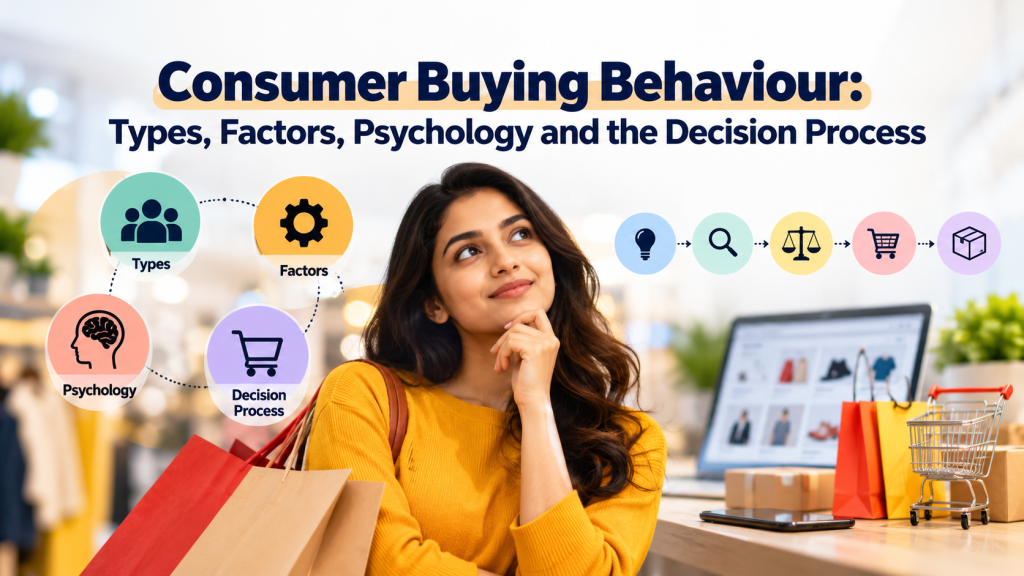
This guide explains what consumer buying behaviour is, why it matters, the four classic buying types, the factors and psychological forces behind purchases, the five-stage decision process, and how businesses can study and apply it responsibly.
What Is Consumer Buying Behaviour?
Consumer buying behaviour is the pattern of thoughts, feelings and actions people go through when they decide whether to buy a product or service, which one to buy, from whom, and what to do after the purchase.
It sits inside the wider field of consumer behaviour. Consumer behaviour is the study of how individuals and organisations choose, buy, use and dispose of goods, services and ideas to satisfy their needs and wants. The American Marketing Association’s explanation of consumer behaviour and purchasing decisions frames the field in just this broad way, and it also lists the four buying-behaviour types covered later in this article.
Consumer behaviour, consumer psychology and buying behaviour: how they differ
These terms overlap, but they are not identical.
- Consumer behaviour is the broadest term. It covers the whole cycle: choosing, buying, using and disposing.
- Consumer buying behaviour (also called consumer purchasing behaviour) narrows the focus to the decision to buy and the actions around it.
- Consumer psychology is the scientific lens. It explains the mental processes, such as motivation, perception, learning and attitudes, that sit underneath the visible behaviour.
The cycle also stretches beyond the checkout. A shopper notices a need before buying, compares options during buying, and judges the product, returns it or recommends it afterwards. A brand that studies only the moment of payment misses most of the story.
A simple example: someone whose old pressure cooker breaks may check reviews, ask relatives, wait for a festive offer, pay by UPI, and later post a rating. Every one of those steps is part of consumer behaviour.
Why Is Consumer Behaviour Important in Marketing?
Marketing decisions are bets about people. Understanding consumers turns guesses into informed choices. Each benefit below maps to a real decision.
- Product development: Observing what frustrates users guides feature choices. A brand that finds shoppers struggling with bulky packaging may redesign it.
- Segmentation and targeting: Needs differ across groups, so businesses divide the market and choose where to compete. Our guide on how segmentation, targeting and positioning influence consumer buying decisions walks through the STP process step by step. The key idea is that identifying different customer needs lets a company group buyers, select the groups it can serve best, and position its product for them.
- Communication and promotion: Knowing where people look for information tells a brand which channels and messages to invest in.
- Pricing and value perception: Shoppers judge price against perceived value, not cost alone. That affects whether a business chooses premium pricing, bundles or discounts.
- Customer experience: Understanding friction points, such as slow delivery or confusing returns, shows where service needs work.
- Brand positioning: Learning what customers associate with a brand reveals how to stand apart from competitors.
- Retention and loyalty: Repeat-purchase patterns show why customers stay or leave, which shapes loyalty schemes and after-sales contact.
- Resource allocation: Evidence about customers helps leaders spend budgets where response is strongest instead of spreading them evenly.
Understanding consumers improves the quality of decisions. It does not guarantee sales, because competition, timing and execution matter too.
What Are the Four Types of Consumer Buying Behaviour?
The four-type classification is widely taught in marketing management and is usually traced to Henry Assael, then popularised by Philip Kotler. It sorts purchases along two lines: how involved the buyer is, and how different the available brands seem.
Complex Buying Behaviour
This occurs when involvement is high and the buyer sees significant differences between brands. The purchase is usually expensive, infrequent, risky or tied to identity.
- Characteristics: extensive research, careful comparison, a learning phase before preferences form.
- Example: buying a first car. The buyer reads reviews, compares mileage, safety ratings and service networks, test-drives several models, and consults family.
- Marketing implication: provide detailed, trustworthy information, comparison tools and knowledgeable sales support.
Dissonance-Reducing Buying Behaviour
Here involvement is high, but the brands look fairly similar. The buyer cares about the purchase yet finds little to separate the options, so price and convenience often tip the balance.
- Characteristics: quicker decisions than in complex buying, followed by doubt about whether the right choice was made.
- Example: choosing a mid-range refrigerator or a mattress from several comparable brands. After buying, the shopper keeps reading reviews and wonders if another model was better.
- Marketing implication: reassure after the sale through warranties, clear onboarding, confirmation messages and satisfied-customer stories.
Habitual Buying Behaviour
This is low-involvement buying with few perceived differences. People buy on autopilot because thinking hard about a small purchase is not worth the effort.
- Characteristics: repeat purchases, strong role for familiarity, shelf position and convenience.
- Example: buying the usual salt, tea or detergent during the monthly grocery run.
- Marketing implication: keep the product visible and available, use repetition in advertising, and use promotions or trial offers to disturb the routine when you are the challenger.
Variety-Seeking Buying Behaviour
Involvement is low, but the brands seem different. Buyers switch for the sake of trying something new, not because they are unhappy.
- Characteristics: frequent brand switching, experimentation, openness to new flavours or formats.
- Example: a shopper who picks a different biscuit or instant-noodle flavour each week.
- Marketing implication: market leaders defend shelf space and keep ranges fresh; challengers use coupons, free samples and novelty to encourage a try.
These four types describe purchase situations. They are not personality types, and the same person can show all four in a single week.
Factors Affecting Consumer Buying Behaviour
No single factor decides a purchase. Cultural, social, personal, psychological, situational and digital forces interact, and people respond to them differently.
Cultural Factors
Culture is the set of shared values, customs and beliefs a person grows up with. Subcultures, such as regional, religious or language communities, add finer layers, and social class shapes aspirations and spending. In India, regional food habits, festival traditions and family expectations visibly shape what, when and how people buy.
Social Factors
Family is often the most influential group, especially for household purchases. Friends, colleagues and reference groups set norms, and online communities now extend that circle. Word-of-mouth recommendations carry weight because they come from people the buyer knows or relates to.
Personal Factors
Age, life stage, occupation, lifestyle, income and personal taste all matter. A new parent, a college student and a retiree may want entirely different things from the same category. Economic circumstances set the boundaries of what is possible.
Psychological Factors
Motivation, perception, learning, beliefs and attitudes shape how people interpret offers. Memory affects which brands come to mind, and perceived risk, whether financial, functional or social, can stall a purchase. These are explored further in the next section.
Situational and Economic Factors
The moment matters. Urgency, store environment, ease of reaching the product, stock availability, price changes and promotions can all override a stated preference. Disposable income and general economic conditions also play a role. NielsenIQ’s latest research on consumer spending priorities and purchasing trends is a useful reference here, as the next paragraph explains.
NielsenIQ’s Consumer Outlook: Guide to 2027, based on a survey of more than 21,000 consumers in 31 countries, reports that 34% of global consumers feel financially worse off than a year ago. It also finds that quality and performance now narrowly outrank affordability as the main test of whether a purchase feels worthwhile (34% versus 31%). In other words, even under budget pressure, many shoppers are judging value, not just price.
Digital and Technological Influences
Online reviews, star ratings, search results, influencer recommendations, personalised ads and social commerce now shape discovery and trust. AI-assisted tools add a new layer. In the same NielsenIQ report, 55% of consumers said AI recommendations had influenced a consumer-goods purchase, and 27% said they already use AI shopping assistants. These are survey findings on one set of respondents, so treat them as an indicator of direction, not a universal figure.
To see how these shifts fit the bigger picture, read about marketing trends reshaping how consumers discover and choose brands in 2026. Changing expectations around digital discovery, personalisation and brand interaction are changing the buying journey itself.
How the factors interact
A festive-season sale (situational) may matter more to a budget-conscious family (personal) that trusts a relative’s advice (social). A different household might ignore the same sale because the brand does not fit its values (cultural and psychological). That is why marketers study combinations of factors, not isolated ones.
Consumer Psychology: Why Do People Buy What They Buy?
Consumer psychology looks inside the decision. Some of the ideas below are well established in research; others are useful marketing interpretations. Treat none of them as universal laws.
Needs, wants and motivation. A need is a gap that must be filled, such as food or transport. A want is a preferred way of filling it. Marketing rarely creates needs, but it shapes the wants attached to them.
Perception and selective attention. People notice only a fraction of the messages around them. They tend to attend to what is relevant to current goals, which is why a person planning to buy a bike suddenly sees bike ads everywhere.
Emotion. Feelings influence choices even when people believe they are being logical. Pride, comfort, fear of missing out and trust all enter the decision. Emotional appeal works best when it is backed by a product that delivers.
Perceived value and price sensitivity. Value is what the buyer believes they get relative to what they give up. Sensitivity to price varies by income, category and how easy comparison is. Price comparison apps have made this comparison simpler for many Indian shoppers.
Familiarity, trust and loyalty. Known brands feel safer, which lowers perceived risk. Loyalty can be genuine preference or just habit, and marketers should know which they are dealing with.
Social proof. People often look to others’ choices as a guide, especially when uncertain. Ratings, review counts and testimonials work on this tendency. Reviews can also be manipulated, so thoughtful shoppers look for detailed, balanced feedback.
Loss aversion and scarcity. Research in behavioural economics, notably Kahneman and Tversky’s prospect theory, finds that losses tend to feel stronger than equivalent gains. Marketers use this when they highlight limited stock or expiring offers. The tactic can backfire when buyers sense that the urgency is artificial.
Impulse and habit. Impulse purchases are unplanned and often triggered by the environment, such as a checkout display or a flash sale. Habitual purchases are repeated with little thought. The two behave differently, and the marketing needed to encourage them differs too.
Cognitive biases. Anchoring, where the first price seen becomes a reference point, and the decoy effect, where a third option makes another look better, are examples. They explain some decisions, but they do not explain all of them. Context and individual differences matter.
Brand perception is also formed by direct experience. Many brands use events and live activations so people can try, feel and judge for themselves. How experiential marketing influences consumer perception and brand preference is worth reading if you want to see why hands-on experiences help consumers evaluate a product and build an emotional connection with a brand.
The Five Stages of the Consumer Buying Decision Process
The conventional model describes five stages: need recognition, information search, evaluation of alternatives, purchase decision and post-purchase behaviour. We will follow one example, buying a smartphone, through all five. The persona is hypothetical.
Need Recognition
The process starts when a person notices a gap between the current and desired situation. Our shopper’s phone battery now lasts half a day, and the camera struggles in low light. The trigger may be internal, such as frustration, or external, such as a friend’s new phone or an advertisement.
Information Search
The shopper searches online, watches review videos, visits brand websites, asks colleagues and notes festive-season offers. Sources fall into personal (family, friends), commercial (ads, brand pages), public (independent reviews) and experiential (handling the phone in a store).
Evaluation of Alternatives
Now the shopper compares battery life, camera quality, price, after-sales service, resale value and brand reputation. Each person weights these differently. A photography enthusiast might rank camera first, while a cost-conscious buyer might give most weight to price and warranty.
Purchase Decision
The shopper chooses a model, then a seller, a payment method and a channel. Delivery speed, return policy, exchange offers and the ease of paying by UPI or card can still change the outcome at this stage. Unexpected factors, such as a negative review or a friend’s opinion, can derail the plan.
Post-Purchase Behaviour
After buying, the shopper compares reality with expectations. Satisfaction can lead to repeat purchases, positive reviews and recommendations. Doubt, known as cognitive dissonance, may send the buyer back to read reviews of rejected models. Disappointment may lead to a return, a complaint or a switch of brand.
Skipping, combining and repeating stages
The model is a framework, not a script. For a low-involvement purchase, such as a packet of biscuits, a shopper may jump from need to purchase with little search. In complex purchases, people loop back, searching again after a new idea or price change. Online journeys also blur the stages, because discovery, comparison and purchase can occur within a single session.
Real-World Examples of Consumer Buying Behaviour
The scenarios below are illustrative and hypothetical. They are not verified case studies.
Example 1: A smartphone purchase (hypothetical)
- Need: replace an ageing phone that no longer meets daily needs.
- Influences: budget, peer opinion, reviews, festive discounts.
- Process: a full five-stage journey over several weeks, matching complex or dissonance-reducing behaviour depending on how different the models seem.
- Marketing implication: clear specification comparisons, honest reviews and post-purchase support reduce doubt.
Example 2: Weekly grocery shopping (hypothetical)
- Need: restock staples.
- Influences: habit, shelf placement, convenience, nearby availability, and small price promotions.
- Process: very short, mostly habitual buying, with occasional variety-seeking in snacks or beverages.
- Marketing implication: reliable availability and visible placement matter more than long persuasive messages. Challenger brands may need trial packs to break the routine.
Example 3: A personal-care or fashion purchase (hypothetical)
- Need: a skincare product, or an outfit for a family wedding.
- Influences: identity, peer or influencer recommendations, ingredient or fabric concerns, and perceived risk if the product might not suit the buyer.
- Process: moderate research, heavy reliance on reviews and photos from real users.
- Marketing implication: authentic reviews, easy size or shade guidance and hassle-free returns lower the perceived risk.
Example 4: An online order with delivery doubts (hypothetical)
- Need: buy a gift for delivery by a specific date.
- Influences: delivery estimates, return policy, payment options, and seller reputation.
- Process: the shopper abandons a cart because the delivery date is unclear, then buys from a site that shows a firm date.
- Marketing implication: operational clarity is also a marketing message. Transparent delivery and return information can support conversion.
How Businesses Can Analyse Consumer Behaviour
No method gives the whole picture. Strong teams combine several.
- Surveys and interviews: reveal stated needs, attitudes and satisfaction. Limit: people do not always accurately report or predict their behaviour.
- Focus groups and qualitative research: explore reasons and language in depth. Limit: small samples and group influence can distort views.
- Website analytics and funnel analysis: show where visitors drop off. Limit: they show what happened, not why.
- Search-query and keyword analysis: expose the questions and phrases people use, which indicate intent. Limit: search data covers only people who use search.
- Purchase history and repeat-purchase analysis: reveal loyalty and buying cycles. Limit: it says little about non-buyers or competitor purchases.
- Reviews, feedback and social listening: capture unprompted opinions. Limit: vocal customers may not represent everyone, and some reviews are not genuine.
- A/B testing: compares two versions of a message, page or offer. Limit: results apply to the tested context and need enough traffic to be reliable.
- Segmentation and cohort analysis: group customers by traits or by start date to compare behaviour over time. Limit: groups simplify individuals, and poor data produces poor segments.
AI is also entering this work. It can support personalisation, customer-data analysis, campaign optimisation and insight generation by finding patterns faster than manual review. For a deeper look, see how AI is changing modern marketing and consumer decision-making. A useful distinction is between what tools do reliably today, such as pattern detection and testing at scale, and what remains aspirational, such as fully autonomous decision-making. Human judgement is still needed to interpret results and set ethical limits.
Responsible data collection and ethics
Consumer research depends on trust. Businesses should:
- collect only the data they need and say clearly how they will use it;
- obtain informed consent and respect opt-outs, in line with applicable privacy law such as India’s Digital Personal Data Protection Act, 2023;
- protect stored data and limit access;
- avoid manipulative tactics, such as fake urgency, hidden charges or targeting people’s vulnerabilities.
Sound research helps customers get what they actually need. Manipulation may win a sale and lose a relationship.
How Consumer Buying Behaviour Shapes Marketing Strategy
Insights matter only when they change decisions. Here is how research feeds into strategy.
- Product features and positioning: if buyers rank durability above novelty, build and message around durability.
- Segmentation and target audience: research reveals which groups have the strongest need and are reachable.
- Pricing and promotions: knowing how price-sensitive a segment is guides whether to discount, bundle or hold a premium. Occasional festive offers can suit price-sensitive segments, while frequent discounting can weaken perceived quality for others.
- Advertising and creative: habitual categories reward repetition and distinctiveness, while complex purchases reward detailed explanation.
- Distribution and convenience: place products where the target customer already shops, online or offline.
- Customer experience and post-purchase communication: reassurance, support and timely follow-up address dissonance and encourage repeat purchase.
These choices improve the odds of relevance. They cannot guarantee results, because customer behaviour shifts and competitors respond.
Frequently Asked Questions About Consumer Behaviour
What is consumer behaviour in marketing?
It is the study of how individuals and organisations choose, buy, use and dispose of products, services and ideas to meet their needs. Marketers use it to design offers, messages and experiences that fit real customers.
What are the four types of consumer buying behaviour?
Complex, dissonance-reducing, habitual and variety-seeking. They differ by the buyer’s level of involvement and by how different the available brands appear.
What are the five stages of the consumer buying decision process?
Need recognition, information search, evaluation of alternatives, purchase decision and post-purchase behaviour. Buyers may skip or repeat stages depending on the purchase.
What are the four major factors affecting consumer behaviour?
The classic grouping is cultural, social, personal and psychological. This article adds situational, economic and digital influences, because they matter a great deal in current markets.
How does consumer psychology influence buying decisions?
Motivation, perception, emotion, beliefs and memory shape what people notice, how they judge value and which brands they trust. Biases such as loss aversion can also tilt choices, though their strength varies with the person and the situation.
What is the difference between consumer behaviour and consumer buying behaviour?
Consumer behaviour covers the whole cycle of choosing, buying, using and disposing. Consumer buying behaviour focuses on the purchase decision and the actions around it.
Why is consumer behaviour important for businesses?
It helps businesses build products people want, target the right segments, set suitable prices, communicate effectively and keep customers. It improves decisions but does not guarantee outcomes.
How can marketers study consumer buying behaviour?
By combining surveys, interviews, analytics, search data, purchase history, review analysis and A/B testing, while respecting privacy and consent. Using more than one method reduces the blind spots of each.
Conclusion
Consumer buying behaviour explains why the same product wins one shopper and loses another. Purchases are shaped by inner forces, such as motivation, perception and trust, and by outer ones, such as family, culture, budget, timing and digital information. The four buying types and the five-stage process give marketers a map, though real customers often wander off it.
The businesses that benefit most treat research as an ongoing habit. They watch how customers search, compare and feel after buying, and then adjust products, prices, messages and service accordingly. Done responsibly, understanding consumer buying behaviour is not about steering people into purchases. It is about making it easier for the right customers to find something worth buying.