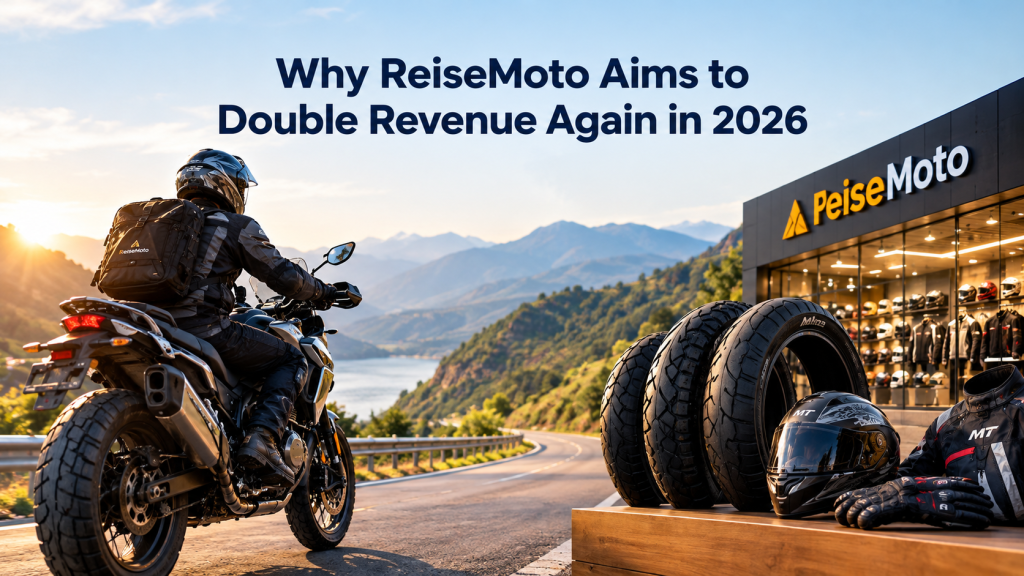
Most Indian two-wheelers still exist to get someone to work and back. But a smaller, faster-growing group of riders buys bikes for weekends, long tours and the pure pleasure of riding. They want better tyres, safer helmets and proper riding gear. ReiseMoto sits right in that gap, and the company is reportedly aiming to double revenue again in 2026.
This blog explains who ReiseMoto is, why the premium two-wheeler market gives it room to grow, and what could help or hinder a big jump.
The premium two-wheeler boom is also pulling listed players into the spotlight, as seen in our explainer on the Hero Motors IPO 2026 and how it differs from other Hero group companies.
Who Is ReiseMoto?
ReiseMoto began as a premium two-wheeler tyre brand under the Mahansaria Group, “designed in Europe and engineered in India.” It is built on a partnership with the European brand Mitas. The group entered a 76:24 joint venture with Mitas to set up a 30-plus-acre manufacturing facility in Saykha, Gujarat.
The plant makes performance tyres under the Mitas name for Europe and North America and under the Reise name for India. At launch, the company introduced 26 SKUs in its first phase under six sub-brands, all sharing the engineering of Mitas tyres proven in rallies such as the Paris-Dakar.
Since then, ReiseMoto has grown from a tyre maker into a wider riding brand. Its retail stores now stock over 30 brands covering helmets, jackets, gloves, boots, protectors, luggage and more than 125 premium European tyres.
From B2B Exporter to D2C Lifestyle Brand
The biggest shift in the story is the business model. According to an interview with founder Yogesh Mahansaria, the company evolved from an established European tyre exporter into a direct-to-consumer premium lifestyle brand for Indian motorcycle enthusiasts, backed by a capital expenditure programme of more than ₹350 crore that avoids the “burn cash” startup model.
This matters for growth. A business selling only to manufacturers depends on a few large buyers. A business that sells directly to riders can earn higher margins, build a brand and sell more products to the same customer over time.
Why the Premium Two-Wheeler Market Is Growing
ReiseMoto’s ambitions rest on a broader shift in India:
- Manufacturers are moving up the value chain. In FY26, Indian two-wheeler makers are prioritising higher-margin, large-displacement motorcycles and exports to offset slow commuter sales.
- Premium models bring in more revenue. Industry analysts have noted that rising preference for executive and premium motorcycles lifts revenue even when volume growth is modest, helped by improving incomes in urban and semi-urban markets.
- The premium niche is still small. The founder has said the premium and performance segment is currently 10 to 15 percent of the Indian two-wheeler market and could double as more premium models arrive and consumers become more affluent.
Every premium bike sold creates demand for better tyres, protective gear and accessories. That is the ecosystem effect behind ReiseMoto’s pitch.
How the Ecosystem Fuels Growth
1. More premium bikes, more accessory demand.
Riders of performance and adventure motorcycles tend to upgrade tyres, helmets and protective gear. A growing base of premium bikes expands the market for all of it.
2. A retail footprint that builds trust.
Tyres and helmets are safety products, and many buyers want to see and try them. ReiseMoto’s stores began in Mumbai and spread quickly. It opened four new stores in just four weeks, reaching Pune as its fifth city after Mumbai, Gurugram, Bengaluru and Chennai, with over 15,000 square feet of retail space.
3. Local manufacturing.
Making tyres in Gujarat gives the company more control over cost and supply. The founder has previously said the plant was being expanded to double capacity to four million tyres, backed by a ₹250 crore investment already made and a further ₹125 crore planned. Capacity gives the company room to chase higher sales.
4. A wider product basket.
Selling tyres, helmets and apparel together raises the value of each customer. It also helps the brand move beyond a single product category. The company added pan-India distribution for MT Helmets and the launch of the MT Stinger 2 in April 2026.
What Could Slow a 2x Target
Doubling revenue is hard, and a base that is already growing makes each repeat harder. Several risks matter:
- Small starting market. The premium segment is a minority of total two-wheeler sales.
- Competition. Established global tyre makers are strong rivals, and tracking sites list names such as Pirelli, Michelin and Bridgestone among its competitors.
- Export exposure. Because the plant also serves overseas markets, trade policy matters. Shifting rules, such as those discussed in our report on the US tariff law raising uncertainty for exporters, can change export economics quickly.
- Rider affordability. Premium bikes and gear are often bought on credit. When borrowing costs rise, demand can soften, which is why the RBI’s repo rate hike and its impact on loans and EMIs is worth watching for any premium consumer brand.
- Capital intensity. Plants and stores need ongoing investment, so growth has to be funded carefully.
The Marketing Lesson Behind the Growth
ReiseMoto’s rise is also a case study in brand strategy. It targets a defined group of riders, builds products and stores for them, and positions itself as the aspirational choice. That is the logic behind segmentation, targeting and positioning, explained simply in our guide to STP marketing. Brands that know exactly who they serve usually grow faster than those trying to please everyone.
What It Means for Riders and the Industry
If the premium ecosystem keeps expanding, riders can expect:
- More choice in tyres and safety gear, including European-standard products
- Better local availability and after-sales support
- Pressure on global brands to compete on price and service in India
- A stronger culture of safety and protective riding
Final Thoughts
ReiseMoto’s push for another year of rapid revenue growth rests on real tailwinds: a premium segment that is still small but growing, local manufacturing capacity, a fast-growing store network and a shift to selling directly to riders. Whether it hits 2x depends on execution, competition, trade conditions and consumer borrowing costs. Either way, the brand shows how a premium two-wheeler ecosystem can turn passionate riders into a sizable business.