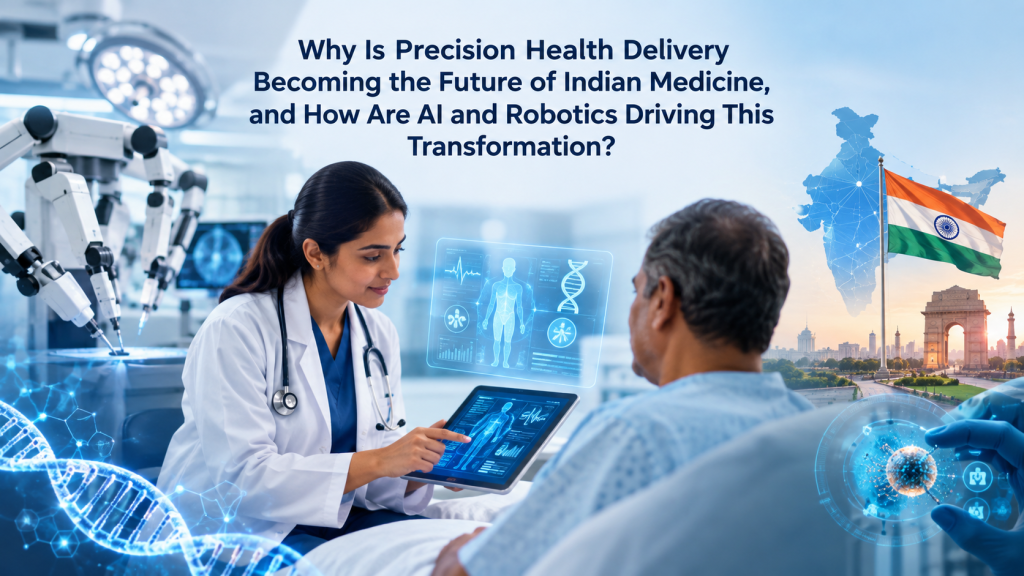
Two patients walk into a hospital with the exact same diagnosis. Under the medicine most Indians have grown up with, they’d likely receive the same standard treatment protocol. Under the model India’s own science and health leadership is now actively building toward, they could receive two genuinely different treatment plans — each calibrated to their individual genetic profile, environmental exposure, lifestyle, and even their specific disease subtype. That shift, from one-size-fits-all medicine to precision, personalised care, is what Dr. Jitendra Singh, Union Minister of State for Science and Technology and Earth Sciences, described in considerable detail just this week as the defining direction of Indian healthcare’s next phase.
What the Minister Actually Said
Speaking at the inaugural session of the International Conference of the Society of Robotic Surgery (SRS India 2026) on October 2-3, 2026, Dr. Singh laid out a vision considerably broader than robotic surgery alone. His core argument: robotics, artificial intelligence (AI), and nanoscience are converging to form an integrated ecosystem that will transform healthcare delivery by enabling treatment genuinely tailored to individual patients — even when two people share the exact same diagnosis.
Crucially, Singh was explicit that robotics in medicine should not be viewed as a technology limited to surgery. He described it as a tool poised to become a key enabler across every branch of medicine, extending into diagnostics, treatment, and therapy — with applications he expects to eventually span fields like robotic medicine, robotic endocrinology, and robotic cardiology, well beyond the operating theatre where robotic assistance is already most familiar to patients and clinicians alike.
This matters as a framing shift in itself. Much of the public conversation around medical robotics in India has, until now, centered almost entirely on robot-assisted surgical procedures. Singh’s remarks signal that India’s policy and scientific leadership see the technology’s real long-term value as running considerably wider — into the diagnostic and therapeutic processes that happen before and after any surgical intervention.
The Genomic Scale Problem Driving This Push
One of the more concrete, numbers-grounded parts of Singh’s address dealt with why AI and robotics aren’t optional add-ons to precision medicine in India specifically, but close to a structural necessity. He pointed to the Genome India Programme, under which 10,000 individuals have already been sequenced — and voiced hope that India could eventually extend genetic sequencing to every newborn, and potentially toward population-wide coverage.
The scale challenge embedded in that ambition is enormous. Managing and analysing genetic data at the level required for a population of roughly 1.4 billion people is simply not achievable through traditional manual analysis — it requires, as Singh put it, the “optimal use of AI and robotics” to process, interpret, and act on genetic information at a volume no human-led system could realistically handle. This is the core logic connecting India’s genomics ambitions directly to its AI and robotics investment: precision medicine at India’s population scale isn’t a choice between traditional and tech-enabled healthcare delivery — the traditional approach genuinely cannot scale to meet the ambition being described.
Beyond Surgery: Where Robotics Is Already Extending
Singh’s speech wasn’t purely forward-looking aspiration — he cited a concrete, already-demonstrated example of how far tele-robotics specifically has already progressed in practical application. In February 2026, an indigenously developed tele-robotic ultrasonography system allowed a doctor based in Delhi to conduct a real-time ultrasound examination of a patient located more than 12,000 kilometres away, in Antarctica. That single demonstration captures precisely why Singh described tele-robotics as particularly relevant for a country of India’s scale, diversity, and geographical spread — the same underlying technology that connected a Delhi physician to a patient in Antarctica is, in principle, equally capable of connecting a specialist in a metro hospital to a patient in a remote rural district who would otherwise have no access to that level of specialist care at all.
This is a genuinely important distinction to draw out: much of the public narrative around AI and robotics in healthcare, in India and globally, centers on urban, well-resourced hospital settings. Tele-robotics specifically addresses the opposite problem — extending specialist-level diagnostic and treatment capability into geographies that have historically had little to no access to it, a gap that India’s own medical college expansion has been working to narrow from a different angle, by training more doctors and specialists in the first place.
Nanomedicine and the Next Generation of Drug Delivery
A further, less discussed thread in Singh’s remarks dealt with nanomedicine — the application of nanoscale engineering to drug delivery and treatment design. He specifically cited ongoing Indian efforts to develop oral insulin, explaining that nano-level innovations could help overcome long-standing limitations in conventional drug delivery methods, opening up genuinely new possibilities for how chronic conditions like diabetes are managed. An oral insulin formulation, if successfully developed and brought to market, would represent a significant quality-of-life shift for the millions of Indians currently dependent on injectable insulin — removing one of the more burdensome, adherence-limiting aspects of long-term diabetes management.
This nanomedicine thread connects directly back to the broader precision-medicine framing Singh built his speech around: delivering a drug more precisely, at the right dose, to the right location in the body, with fewer systemic side effects, is itself a form of personalisation — treatment engineered around how an individual patient’s body actually processes and responds to a given therapy, rather than a one-size-fits-all dosing and delivery approach.
India’s Changing Disease Profile Adds Urgency
Singh also pointed to a demographic and epidemiological shift that strengthens the case for precision approaches specifically: diseases traditionally associated with later stages of life are increasingly being seen among younger people in India, even as infectious diseases continue to coexist alongside this growing burden of metabolic and lifestyle-related disorders. This dual disease burden — infectious disease that hasn’t gone away, layered against a rising, younger-onset wave of chronic and metabolic conditions — is precisely the kind of complex, heterogeneous health landscape that benefits most from precision, individually-tailored treatment approaches rather than standardised, population-wide protocols designed around an earlier, simpler disease profile.
The Market Is Already Moving in This Direction, Globally and in India
Singh’s remarks align closely with where independent market research places the broader trajectory of AI-driven precision medicine. According to a March 2026 analysis from MarkNtel Advisors, the global AI in Precision Medicine market is projected to grow at a compound annual growth rate (CAGR) of roughly 31.35% through 2032, reaching an estimated $10.32 billion. Within that market, oncology represents the single largest therapeutic application, accounting for roughly 32.5% of total market share in 2026 — a figure consistent with how actively AI-driven precision approaches are already being deployed specifically in cancer diagnosis and treatment planning, an area where getting the right, individually-calibrated treatment matters enormously given the stakes involved for patients.
India specifically has been identified as one of the Asia Pacific region’s most AI-ready healthcare markets, with rising adoption of generative AI tools and growing demand for coordinated, technology-enabled care — a positioning that gives real commercial and investment weight to the kind of national-level ambition Singh articulated, rather than leaving it as purely aspirational government rhetoric disconnected from where actual capital and research investment is flowing.
Why This Matters for Indian Healthcare’s Broader Trajectory
Stepping back, Singh’s framing captures something genuinely significant about where Indian medicine is heading structurally. Medicine, as he described it, is entering a new phase driven by the convergence of AI, biotechnology, nuclear medicine, quantum technologies, nanomedicine, and robotics — not any single one of these technologies in isolation, but their combined, overlapping application across diagnostics, treatment, and ongoing disease management.
For a healthcare system as large, diverse, and geographically uneven as India’s, this convergence offers something genuinely distinct from how precision medicine has typically developed in smaller, more resource-concentrated healthcare systems elsewhere. The same tele-robotic infrastructure that connected a Delhi clinician to a patient in Antarctica is the kind of capability that, deployed domestically, could meaningfully narrow the gap between India’s urban specialist-hospital corridors and its underserved rural districts — complementing, rather than replacing, the kind of workforce-side investment reflected in how India’s medical college capacity has expanded over the past decade.
It’s also worth situating this within India’s broader pattern of technology-led national ambition. Much as the country has pursued deliberate, government-backed pushes into semiconductor manufacturing and AI infrastructure more broadly, Singh’s remarks suggest a comparable, deliberate strategic bet being placed on AI and robotics specifically within healthcare — treating precision medicine not as a distant, decades-away aspiration, but as an active policy and research priority with concrete programmes, like Genome India, already generating real data and momentum today.
The Honest Caveats
It’s worth tempering some of this ambition with realism about where India currently stands. Genome India’s 10,000 sequenced individuals is a meaningful start, but represents a vanishingly small fraction of a population of 1.4 billion — reaching anything resembling population-scale genomic coverage, let alone newborn-level universal sequencing, remains a multi-decade undertaking even under optimistic scaling assumptions. Tele-robotic systems, while genuinely demonstrated in high-profile cases like the Antarctica ultrasound, still require significant infrastructure — reliable connectivity, trained operators, calibrated equipment — to scale from single demonstrations into routine rural healthcare delivery. And broader industry analysis of India’s medical technology adoption describes the transition as “still uneven” across the country, even while acknowledging the clear overall direction of travel toward AI-enabled, more personalised care, particularly in India’s metro and Tier 2 cities first.
The Bottom Line
What Dr. Jitendra Singh laid out this week isn’t a single new announcement so much as a consolidated articulation of where India’s health policy, scientific research, and technology investment are already converging: a future where robotics extends well past the operating table, AI makes population-scale genomic analysis genuinely tractable, nanomedicine reshapes how drugs reach their targets inside the body, and tele-robotics closes the distance between India’s best specialists and its most remote patients. Precision health delivery, in this framing, isn’t a futuristic ambition confined to research papers — it’s the direction India’s actual policy architecture, scientific programmes like Genome India, and healthcare technology adoption are already, measurably, moving toward. Whether that direction translates into genuinely equitable, nationwide precision medicine — reaching India’s underserved regions as readily as its metro hospitals — will depend on how deliberately the infrastructure, workforce training, and rural connectivity supporting these technologies get built out over the years following this week’s remarks.