When people hear “drug-free campaign,” they usually picture police raids, seized narcotics and rehabilitation centres. Haryana has now widened that picture. The state has extended its anti-drug push to cover something far more ordinary: the protein powders, supplements and energy drinks that many young people buy in the name of fitness.
This blog explains what Haryana announced, why the expansion matters for prevention and quality of care, and what still needs to happen for it to work.
Young people’s health habits are already under strain, as shown in our report on why young Indians are developing fatty liver even at a normal weight.
What Haryana Announced
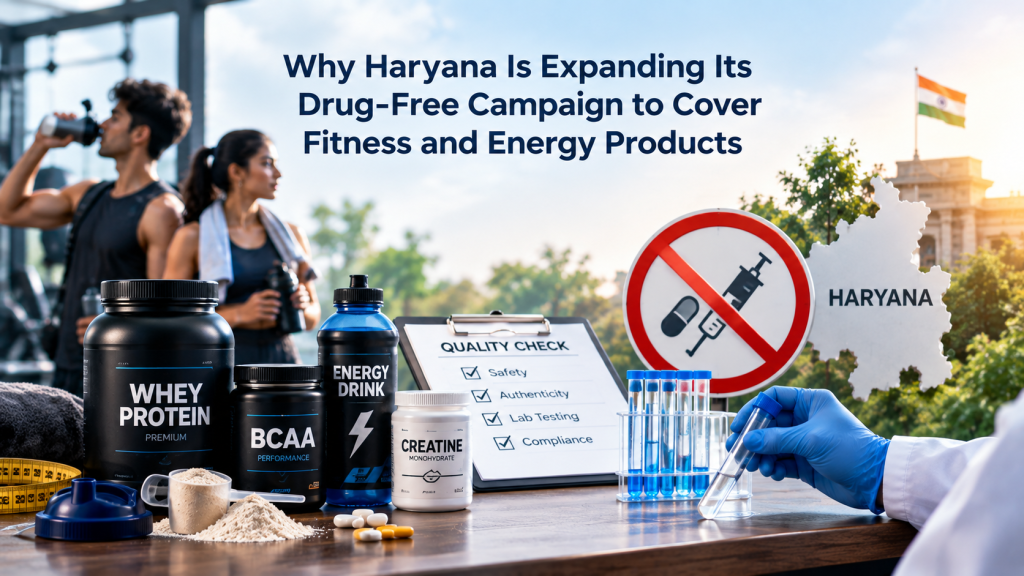
On October 8, 2026, the state said the existing campaign had been widened. According to the PTI report, the “Drug-free Haryana” campaign has been expanded with increased focus on the quality of products related to youth health that are being used more and more in the name of fitness and energy. The government framed it as another step to protect youth from substance abuse and encourage a healthy and positive lifestyle.
What the October 5 Enforcement Drive Found
The first big action was a coordinated drive. The Haryana Food and Drug Administration ran special enforcement drives in all districts at the same time on October 5, inspecting 61 establishments including manufacturers, distributors, retailers and chemist outlets. Inspectors collected 73 samples of nutraceuticals, protein powders and energy drinks, which went to State Food Laboratories in Chandigarh and Karnal and to NABL-accredited labs.
One case stood out. In Rohtak, a “natural protein powder” carried an unsubstantiated “100 per cent natural” claim and lacked mandatory details such as the expiry date, manufacturer’s address and FSSAI licence number, and legal action began under the Food Safety and Standards Act, 2006. For the rest of the samples, further action depends on lab results. Officials said unsafe, substandard, misbranded or non-compliant products will face strict action.
Why Is the Campaign Being Expanded?
The statement does not list every reason, but the logic follows a clear pattern:
- Fitness products are booming among youth. Gym culture, social media and influencer marketing push supplements to people who may not know what is in them.
- Labels can mislead. Claims like “100% natural” are easy to print and hard for a buyer to check.
- Unsafe products harm health quietly. A contaminated or mislabelled product may not look dangerous, but it can affect health over time.
- Prevention works best upstream. Checking what reaches the shelf is cheaper and safer than treating harm later.
This approach adds product safety to a campaign that was already built on enforcement, awareness and community action.
The Foundation: A Campaign Built on Community and Treatment
The expansion rests on work already underway. In July 2026, Chief Minister Nayab Singh Saini called for a people’s movement and announced anti-drug task forces at state, district, subdivision, block, village and ward levels, with a focus on awareness, rehabilitation and dismantling networks. He stressed that the fight against drugs is not merely a law and order issue, but a campaign to protect society, values and humanity.
Earlier data shows how the campaign treats addiction as a health issue as well as a crime. Haryana Police worked with the Health Department to identify people with addiction and ensure their treatment at rehabilitation centres, and surveys in 2024 identified those needing help. Community drives also reached large numbers: by November 30, 2024, 41.66% of Haryana’s villages and 39.74% of its wards had been declared drug-free, with Gram Prahari and Ward Prahari deployed to monitor activity.
Public events keep the message visible. In September 2026, more than 1.35 lakh people took part in the Drug-Free Haryana Faridabad Namo Marathon at Surajkund, where the Chief Minister administered an anti-drug pledge.
How This Could Improve Quality of Care
“Quality of care” here means more than hospital treatment. It covers everything that keeps people safe before and after they seek help.
1. Safer products, fewer preventable cases.
When labs test supplements and drinks, unsafe items can be pulled before they cause harm. That reduces the number of young people who end up needing medical help for avoidable reasons.
2. Better data for doctors.
Test reports show what is actually in popular products. That helps clinicians who see patients using them.
3. Treatment linked to enforcement.
The earlier model of identifying people with addiction and sending them to treatment shows the state is pairing action with care, not just arrests.
4. Stronger health systems.
Good prevention needs enough trained staff and clear quality standards. The challenge is highlighted in our piece on the WHO flagging a growing health workforce gap, and in the discussion of how hospitals may be graded on quality and safety. Both show why prevention and treatment need strong systems behind them.
How This Could Improve Prevention
- Awareness among young people. Schools, colleges and sports bodies already carry the message, and product safety adds a practical lesson on reading labels.
- Accountability for sellers. The government said no business entity compromising the health of the youth will be spared. A visible penalty discourages careless or deceptive sellers.
- Sports as an alternative. The Chief Minister has also stressed connecting youth with sports to build a healthy, drug-free generation.
What Still Needs to Be Proven
An honest view also includes the gaps:
- Lab results are pending. Until test reports come in, it is not known how many of the 73 samples are unsafe.
- Enforcement must be sustained. One-day drives make headlines, but repeat checks make a difference.
- Politics surrounds the issue. Opposition leaders have argued that 16 of Haryana’s 23 districts are classified as highly vulnerable. Readers should weigh such claims against official data.
- Consumers need clear rules. Young buyers benefit most when labels, licences and claims are easy to verify.
What Families and Young People Can Do
These are general tips, not medical advice:
- Check that a product shows an expiry date, manufacturer address and FSSAI licence number.
- Be careful with bold claims such as “100% natural” or “instant results.”
- Buy from trusted, licensed sellers.
- Talk to a doctor or qualified dietitian before using supplements, especially if you are young, pregnant or on medication.
- Seek help early if someone you know is struggling with substance use.
The Bigger Picture: From Treating Illness to Preventing It
Haryana’s move reflects a wider shift in Indian health policy, from reacting to illness toward catching risks early. That idea runs through our explainer on why precision health delivery is becoming the future of Indian medicine. Whether the focus is technology, testing or enforcement, the aim is the same: protect people before harm happens.
Final Thoughts
By bringing fitness and energy products into its Drug-Free campaign, Haryana is acknowledging that threats to young people’s health do not always look like traditional drugs. The expansion pairs inspections and legal action with awareness, community involvement and treatment. Its real impact will depend on lab findings, follow-through and public cooperation. If those hold, the campaign could do more than reduce drug use. It could make everyday health products safer for the young people who rely on them.